
Every week, we get calls from churches, corporate teams, and event planners stuck on the same question. Should we upgrade to an LED video wall or stick with a projector? For decades, projectors were the default answer. That is no longer the case.
At CMG Visuals, we have installed LED video walls in dozens of environments where projectors used to live. Sanctuaries, boardrooms, retail showrooms, ballrooms, home theaters, and broadcast studios. The shift has been fast. This blog breaks down the real differences so you can pick the right technology for your space.
Summary
LED video walls outperform projectors in almost every measurable category. They deliver higher brightness, longer lifespan, better ambient light performance, and lower long term maintenance. Projectors still have a place for temporary displays and specific budget scenarios, but for permanent installs in churches, offices, event venues, and retail, LED video walls now win the comparison in nearly every case. This guide walks through the exact differences that matter when making the decision.
The Case for Projectors
Projectors have been the workhorse of large format display for over 40 years. They are affordable up front and available almost everywhere. For a low-light auditorium or a dark home theater, a good projector can produce a large image at a fraction of the price of an equivalent LED wall.
Projectors also offer flexible screen size. You can adjust the throw distance to expand or shrink the image without new hardware. This has kept them in play for schools, budget churches, and portable event setups.
The Case for LED Video Walls
LED video walls solved the biggest weaknesses of projection. They produce their own light instead of throwing light onto a surface, which means brightness and image quality no longer depend on the room. They also last far longer than any projector bulb and scale to almost any size without losing sharpness.
For a deeper foundation, our blog on what is an LED video wall is a good starting point.
LED Video Wall vs Projector: Key Differences That Actually Matter
Here is where the decision gets clear. These are the categories we walk every client through.
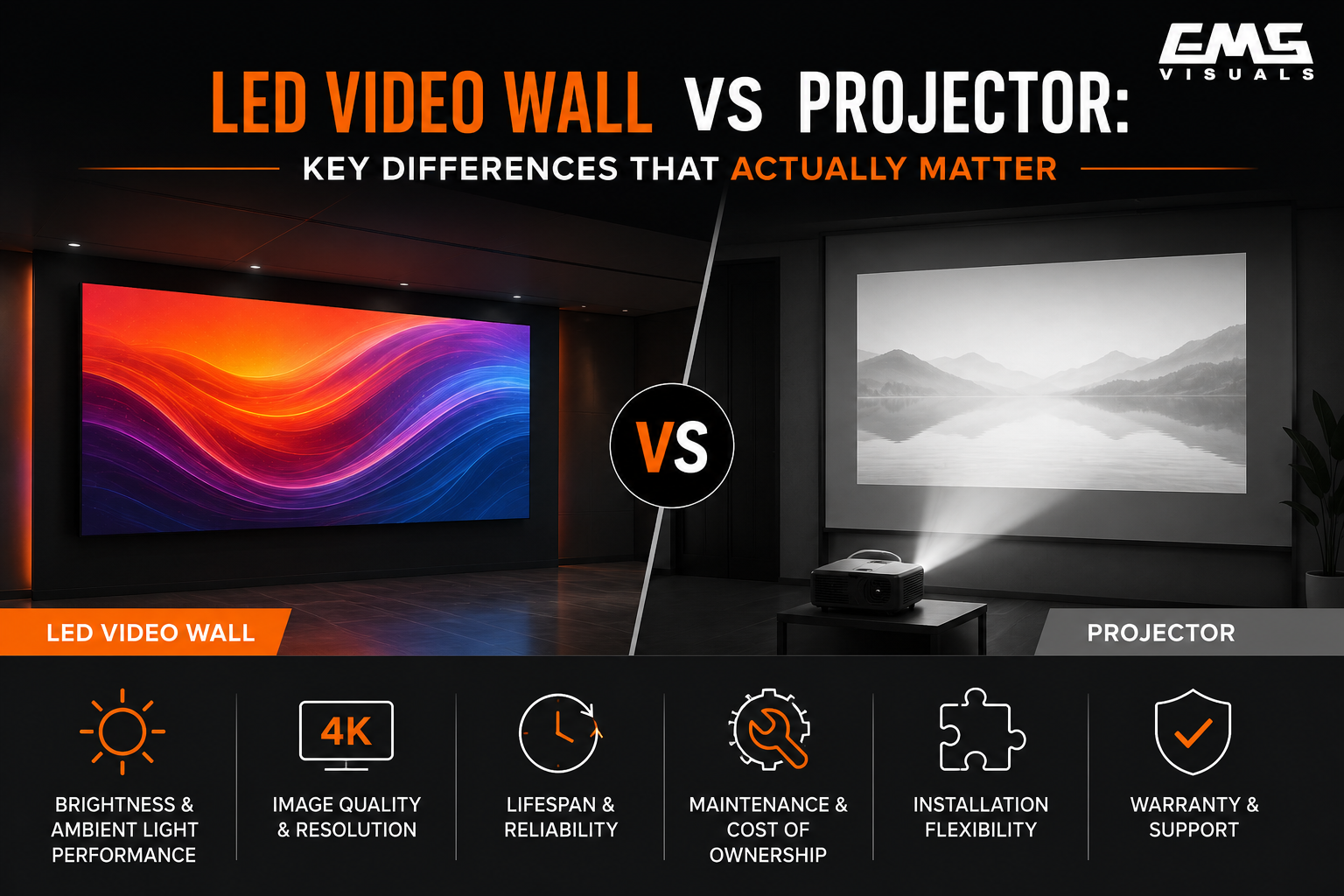
Brightness and Ambient Light Performance
This is the single biggest reason LED walls have replaced projectors. LED video walls typically produce 800 to 1,200 nits indoors and up to 10,000 nits outdoors. A high end projector maxes out around 400 to 600 nits equivalent on the screen surface.
Projectors need a dark or dim room to look good. LED walls stay sharp and vibrant even under bright overhead lights, in sunlit sanctuaries, and in modern glass walled boardrooms. This alone has driven most churches and corporate spaces to switch.
Image Quality and Resolution
LED video walls are made of individual pixels, and the pixel pitch determines how sharp the image is at any viewing distance. Fine pitch LED walls at P1.2, P1.5, or P1.9 rival or exceed 4K projection at close range.
Projectors lose sharpness the larger the image grows because the same amount of light gets stretched across more surface. LED walls stay uniformly sharp because every pixel emits its own light. To understand how pixel pitch shapes image quality, see our blog on what pixel pitch is and why it matters for your business.
Lifespan and Long Term Reliability
Projector bulbs typically last 2,000 to 5,000 hours. Laser projectors run up to 20,000 hours before dimming and needing full engine replacement. LED video walls run for 50,000 to 100,000 hours before brightness drops to half.
For a church running services three times a week or a boardroom running eight hours a day, an LED wall will outlast three or four projector engines.
Maintenance and Cost of Ownership
Projectors demand ongoing attention. Bulbs burn out, dust clogs filters, colors fade, and image alignment drifts. Every year adds hidden costs.
LED walls are modular. If a single panel fails, we replace that module instead of the whole system. Every CMG Visuals install ships with spare parts and is backed by a 5 year hardware warranty plus lifetime product support. For a full breakdown of LED costs over time, see our blog on how to budget for LED video wall installation.
Installation Flexibility and Space Requirements
Projectors need throw distance. That means a long room, a ceiling mount, or a short throw setup that still consumes space. They also require a projection surface, controlled sight lines, and shadow free access.
LED walls hang flat on a wall or truss with no throw distance required. They fit tight spaces, curved walls, custom shapes, corners, and ceiling installations. In older buildings and modern glass boxes alike, LED gives us design flexibility a projector cannot match.
Warranty and Support
Most projector manufacturers offer one to three years of coverage on the base unit, with bulbs and engines excluded or limited. LED video walls from tier 1 suppliers come with 5 year hardware warranties and modular repair options.
Our LED service and repair team supports installs across many states.
Which One Wins for Specific Environments
Every space is different, but the pattern is consistent. Here is how the decision usually plays out.
Churches and worship spaces. LED wins almost every time. Congregations expect crisp visuals from every seat, even under stage lighting. Our P1.9 install at Christ United Methodist in Farmers Branch and P2.6 install at Keystone Church in Mesquite both replaced older projection.
Corporate boardrooms and offices. LED wins for permanent installs. The 135 inch 0.9mm 4K LED wall we installed for WAC Lighting in Long Island is a good example.
Event venues, ballrooms, and hotels. LED wins for permanent installs. Projectors still play a role in temporary rentals where portability matters.
Retail and showrooms. LED wins every time. Retail environments need close range clarity and cannot afford dim projected images competing with store lighting.
Home theaters. Projectors still have a footprint in dedicated dark rooms. High end residential clients are increasingly moving to all in one LED walls for daytime brightness and long term reliability.
When a Projector Still Makes Sense
We are LED specialists, but we will tell any client when a projector is the smarter call. Projectors still work well in three situations.
The first is short term or temporary use, like a school gym event. The second is very tight budgets where the up front cost of LED is out of reach. The third is dedicated dark rooms with controlled lighting where projection can still deliver a good result at lower cost.
Outside of those cases, LED is now the stronger long term choice for almost every professional install.
Real Projects Where LED Beat the Projector
Some of our best examples show the switch in action. Christ United Methodist Church in Farmers Branch replaced projection with a P1.9 LED church screen. Global Harvest Church in Carrollton installed a three screen LED video wall for worship. Grace Avenue Methodist Church in Frisco upgraded to P1.5 LED for a brighter, sharper worship experience.
In corporate, WAC Lighting's Long Island boardroom now runs on a 135 inch 4K LED wall that would have been impossible to match with any projector. Gemmy Industries upgraded their meeting room with our 1609 Mega Series LED for the same reason.
Browse these and more on our past projects page.
Conclusion
For decades, projectors were the only realistic way to show a big image. That era is ending. LED video walls now beat projectors on brightness, image quality, lifespan, maintenance, warranty, and installation flexibility. The only real cases where a projector still wins are short term events, tight budgets, and dedicated dark rooms.
At CMG Visuals, we help churches, businesses, retailers, event venues, and homeowners make this decision every week. If you are weighing an LED video wall against a projector, reach out through our contact page and our team will walk you through the right long term choice for your goals.
Frequently Asked Questions
1. Is an LED video wall more expensive than a projector?
Up front, yes. LED walls cost more per square foot than a projector setup. Over 5 to 10 years, LED usually comes out cheaper thanks to lower maintenance, no bulb replacements, and much longer hardware lifespan.
2. Can I use an LED video wall in a bright room?
Yes, and this is one of the biggest reasons clients switch from projectors. LED walls produce their own light and stay sharp even in bright sunlit spaces, glass boardrooms, and stage lit sanctuaries.
3. How long does an LED video wall last compared to a projector?
An LED video wall runs for 50,000 to 100,000 hours before brightness drops to half. Projector bulbs last 2,000 to 5,000 hours, and laser engines top out around 20,000 hours. LED lasts three to five times longer.
4. Can CMG Visuals help me decide between an LED wall and a projector?
Yes. We start every project with a discovery call to understand your space, lighting, viewing distance, content, and budget. If a projector is the right call, we will tell you. Our LED sales and installation teams handle the process end to end.