The problem most buyers run into isn't a shortage of options. It's that "outdoor LED" covers radically different product categories with radically different performance requirements. An event video wall built for a music festival has almost nothing in common with a permanent digital sign on a hotel exterior — despite both carrying the "outdoor LED" label. Choose the wrong category, and you're looking at costly replacements, poor daytime visibility, or displays that fail under the first heavy rainstorm.
This guide covers the best outdoor LED solutions across five primary commercial use cases, the specs that actually matter, and what to prioritize when evaluating vendors.
Key Takeaways
- IP65 protection is the minimum for any outdoor LED display exposed to rain or dust — not the target.
- Outdoor displays need 5,000+ nits to stay visible in daylight; sports venues typically require 6,000–10,000 nits.
- Farther viewing distances allow larger pixel pitch — match pitch to your audience's position, not the screen size.
- Rental panels, fixed signage, and scoreboards serve different functions and are not interchangeable.
- Choose a vendor without brand-loyalty mandates — they'll spec for your site, not their distributor contracts.
Why Outdoor LED Technology Sets the Standard for Commercial Lighting
Legacy commercial lighting — metal halide, fluorescent, and traditional static signage — shares three weaknesses that make it hard to defend for commercial applications:
- High energy consumption relative to output
- No programmable brightness control for day-to-night conditions
- Zero capacity for dynamic or updateable content
Outdoor LED displays eliminate all three. They operate at a fraction of the energy draw of equivalent HID fixtures, offer programmable brightness from full daylight output down to dim evening levels, and deliver content flexibility that static signage simply cannot match.
The commercial market has recognized this shift. According to Grand View Research, the outdoor LED display market was valued at $7.24 billion in 2022 and is projected to grow at a 15.9% CAGR through 2030.
On the advertising side, global out-of-home spending reached $54.2 billion in 2025 — with digital OOH claiming 47.1% of that total. Commercial operators are moving budget toward dynamic outdoor displays because the ROI on static formats has become harder to justify.
What that growth obscures is the diversity within the category. The right outdoor LED solution for a sports venue looks nothing like the right solution for a retail storefront or a tradeshow activation. Understanding what separates the best options in each use case is where the real purchasing decision happens.
Best Outdoor LED Solutions for Commercial and Professional Use
Any outdoor LED installation should meet five core criteria before anything else:
- IP65 minimum rating for weather and dust resistance
- Brightness calibrated to ambient light conditions at the site
- Temperature durability across the local climate range
- Manufacturer support with clear warranty terms
- Environment-specific design matched to the actual use case
Here's how the five primary commercial categories measure up against those standards.
Outdoor LED Video Walls for Events and Large Venues
Concerts, festivals, outdoor theaters, and live sports events share one visual problem: displays must punch through direct sunlight and stay legible to audiences standing 50–200 feet away. That's the environment event video walls are built for.
The format's defining characteristics are modular panel design for scalable configurations, high nits output, and assembly systems engineered for touring. Products like the ROE Black Quartz — rated at 5,000 nits and IP65, with pitch options from 3.9mm to 6.25mm — represent the current benchmark for outdoor rental event displays.
| Spec Category | Details |
|---|---|
| Brightness | 5,000–7,500 nits |
| Pixel Pitch | 3.9mm–6mm (typical event viewing distances) |
| IP Rating | IP65 minimum |
| Key Considerations | Cabinet weight, rigging compatibility |
| Ideal Use Cases | Outdoor concerts, festivals, sports events, amphitheaters, outdoor conference setups |
| Key Features | Front/rear serviceability, high refresh rate (≥1,920Hz) for broadcast capture, weatherproof enclosures |
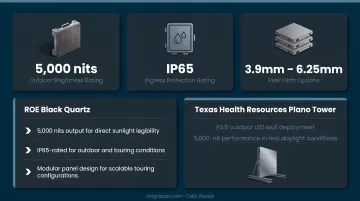
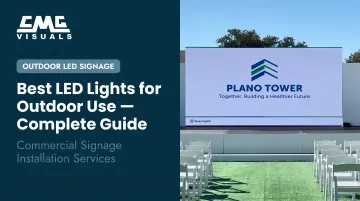
CMG Visuals has deployed outdoor video wall configurations at outdoor events — including a P3.9, 5,000-nit outdoor LED wall at the Texas Health Resources Plano Tower groundbreaking ceremony — demonstrating the practical performance of this spec in real daylight conditions.
Outdoor LED Digital Signage Displays
Retail storefronts, transportation hubs, shopping centers, and corporate campuses run displays around the clock — from pre-dawn darkness through peak afternoon sun. That full brightness range is the core challenge.
Outdoor digital signage addresses it through auto-dimming sensors that adjust output based on ambient light. The result: no washed-out displays at noon, no overdriven screens burning energy at midnight.
The Absen AW Series, rated at 5,000–5,500 nits with pixel pitches from 2.5mm to 3.9mm and IP65, illustrates what fine-pitch outdoor signage delivers for environments where viewers are closer and content detail matters more.
| Spec Category | Details |
|---|---|
| Brightness | Up to 5,000 nits |
| Pixel Pitch | 2mm–4mm (close viewing) |
| IP Rating | IP65/IP67 |
| Ideal Use Cases | Retail storefronts, hotel lobbies (outdoor-facing), shopping center pylons, transit displays, bar/restaurant exteriors |
| Key Features | Auto-dimming sensors, weatherproof tempered glass, remote management via NovaStar or similar control systems |
CMG Visuals uses NovaStar control systems across its installations, providing the content management backbone that makes 24/7 outdoor signage practical to operate and update remotely.
Outdoor LED Scoreboards and Sports Displays
A scoreboard failure mid-game at a professional venue isn't an inconvenience. It's an operational crisis. That's what makes sports displays mission-critical in a way most other outdoor categories aren't. Sports applications add requirements that most other outdoor categories don't face: integration with live scoring and timing data, broadcast-compatible refresh behavior, and structural enclosures built to survive years of weather exposure without maintenance failures.
Daktronics' outdoor display line — rated at 6,000–10,000 nits — represents the upper brightness range required for sunlit stadium environments where the display must remain legible to audiences in fully sun-exposed seating.
| Spec Category | Details |
|---|---|
| Brightness | 6,000–10,000 nits |
| Pixel Pitch | 6mm–16mm (large-venue viewing distances) |
| IP Rating | IP65+ |
| Key Considerations | Structural load rating for permanent mounting |
| Ideal Use Cases | Football, baseball, and soccer stadiums; athletic fields; motorsport venues; arena exteriors |
| Key Features | Live data feed integration, broadcast-safe refresh rates, redundant power systems, corrosion-resistant enclosures |
Structural compliance matters here beyond the display itself. ASCE 7-22 governs loading requirements — including wind, snow, and seismic loads — for permanent mounted structures, and permanent scoreboard installations require engineering review against those standards.
Outdoor LED Rental Displays for Tradeshows and Corporate Events
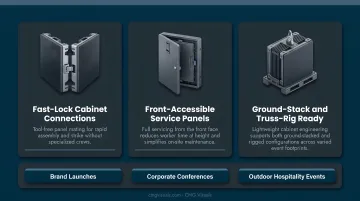
Temporary outdoor activations — brand launches, corporate conferences, outdoor hospitality events, and tradeshows — need displays that can be configured, operated, and struck quickly without specialized tools or large installation crews. Rental-grade outdoor LED solves this through fast-lock cabinet connections, front-accessible service panels, and lightweight cabinets engineered for ground-stacking or truss rigging.
The weight and format of rental cabinets directly affect what configurations are practical on a given event footprint. Tool-free assembly matters not just for speed but for safety — faster setup means less time workers spend at height on rigging.
| Spec Category | Details |
|---|---|
| Brightness | 4,000–6,000 nits |
| Pixel Pitch | 3.9mm–6mm |
| IP Rating | IP65 |
| Key Considerations | Cabinet format for ground-stacking or truss rigging |
| Ideal Use Cases | Outdoor brand activations, tradeshows, corporate events, music festivals, outdoor hospitality |
| Key Features | Fast-lock connections, front-accessible service, portable road cases, touring video processor compatibility |
Permanent Outdoor LED Installations for Hospitality and Corporate Campuses
Hotel facades, corporate headquarters signage, campus wayfinding, and entertainment venue exteriors operate at the highest standard in the category. These displays run continuously for years, often without easy access for servicing.
That constraint puts the entire burden on pre-installation decisions. The engineering choices made before a single panel goes up determine performance across the full lifespan.
A documented example: Daktronics installed approximately 7 million pixels across a ribbon display at J Resort in Reno — roughly 4.5m high, over 45m long, at 8mm pitch, wrapping three sides of the building. That scale of permanent installation requires custom enclosure engineering, structural sign-off, and a support agreement that outlasts any individual component.
| Spec Category | Details |
|---|---|
| Brightness | 5,000–8,000 nits |
| Pixel Pitch | Matched to minimum viewing distance |
| IP Rating | IP66/IP67 for fully exposed surfaces |
| Key Considerations | Full structural engineering compliance |
| Ideal Use Cases | Hotel exteriors, corporate headquarters, houses of worship outdoor displays, entertainment venues, retail flagship facades |
| Key Features | Custom enclosure design, 5-year+ hardware warranty, lifetime product support, certified technician installation |
CMG Visuals offers a standard 5-year hardware warranty with lifetime product support on all sold screens — terms that apply to outdoor fixed installations and provide the long-term coverage that permanent projects require.
How to Choose the Right Outdoor LED for Your Needs
Brightness: Nits vs. Lumens
These two measurements confuse buyers constantly. Lumens measure total luminous flux — how much light a source emits in all directions. That's the relevant unit for lighting fixtures. Nits measure luminance — brightness per square meter of display surface — and that's what matters for any emissive display you need to read in daylight.
For outdoor LED displays:
- 4,000–5,000 nits: Minimum for direct sunlight readability
- 5,000–7,500 nits: Standard for events and commercial signage
- 6,000–10,000 nits: Required for sports venue and stadium applications
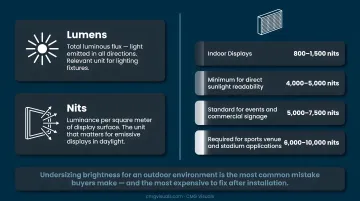
Indoor displays typically run 800–1,500 nits. Undersizing brightness for an outdoor environment is the most common mistake buyers make — and the most expensive to fix after installation.
IP Rating vs. Actual Exposure
Per IEC 60529, the three ratings most relevant to outdoor LED are:
- IP65: Dust-tight; protected against water jets (standard rain and wash-down exposure)
- IP66: Dust-tight; protected against powerful water jets (pressure washing, driving rain)
- IP67: Dust-tight; protected against temporary immersion (standing water, flood risk)
IP65 covers the majority of outdoor installations. Environments near coastlines, subject to routine pressure cleaning, or in flood-prone areas warrant IP66 or IP67 enclosures.
Pixel Pitch vs. Viewing Distance
AVIXA's guidance provides a practical starting point: pixel pitch in millimeters multiplied by 10 gives an approximate minimum viewing distance in feet. A 4mm pitch works for a minimum viewing distance of roughly 40 feet; a 10mm pitch targets audiences starting around 100 feet away.
Getting this wrong in either direction wastes money. Too fine a pitch for a large-venue installation drives up cost without improving perceived resolution. Too coarse a pitch for a close-viewing application produces visible pixelation that undermines the display's purpose.
Why Vendor Independence Matters
Knowing the right specs only gets you halfway there. The other half depends on whether your vendor is recommending what your project actually needs — or what their distributor agreements push them toward.
Buyers working through brand-locked resellers face a structural problem: the recommendation they receive is shaped as much by distributor incentives as by their site requirements. An independent integrator, by contrast, specifies based on the project's actual ambient light, viewing distances, exposure conditions, and operational demands. CMG Visuals operates this way — no brand-loyalty mandates, direct OEM sourcing, and configurations built around the installation rather than around available inventory.
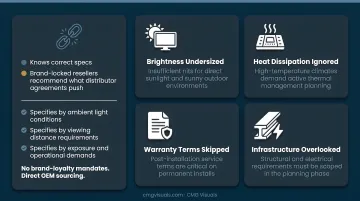
Common mistakes to avoid:
- Undersizing brightness for sunny outdoor environments
- Ignoring heat dissipation requirements in high-temperature climates
- Skipping warranty and post-installation service terms on permanent installs
- Failing to account for structural and electrical infrastructure during the planning phase
Conclusion
Matching an outdoor LED display to your environment — viewing distance, ambient light conditions, structural constraints, and compliance requirements — is what separates a 5–10 year workhorse from an expensive maintenance problem. Brightness, IP rating, pixel pitch, and structural compliance aren't checkbox items. They're the variables that determine real-world performance.
Those specs also connect directly to long-term cost of ownership. Energy efficiency, maintenance accessibility, warranty coverage, and vendor responsiveness shape the actual return on an outdoor LED investment across its full lifespan — often more than the purchase price does.
For venues, event operators, retail locations, and corporate campuses planning an outdoor LED project, CMG Visuals offers no-obligation consultations. NovaStar-certified engineers, direct-sourced product lines, a 5-year hardware warranty, and lifetime product support mean the project is scoped correctly before a single panel ships.
Reach out at cmgvisuals.com or call 214.714.2153.
Frequently Asked Questions
What are the best permanent outdoor LED lights?
The best permanent outdoor installations are custom-engineered to site conditions: IP67-rated enclosures for fully exposed surfaces, brightness of 5,000–8,000 nits for sunlit environments, and certified installation with long-term warranty coverage. A proper site assessment is required before specifying any hardware — off-the-shelf configurations rarely account for real-world exposure variables.
Are LED lights good for outdoor use?
LEDs are the commercial standard for outdoor use. They deliver 50,000–100,000 hours of operational life, maintain brightness across wide temperature ranges, and resist shock and vibration better than legacy HID or fluorescent alternatives.
Is 3000K or 4000K better for outdoor lighting?
3000K produces warm white light suited for ambiance-driven environments like hospitality patios. 4000K produces neutral white better suited for security and commercial task lighting. For outdoor LED video walls and digital displays, color temperature is managed through content calibration rather than fixed fixture specs; it's a separate specification category entirely.
What IP rating is required for outdoor LED displays?
IP65 covers dust ingress and low-pressure water jets — the baseline for weather-exposed outdoor LED displays. Environments subject to pressure washing, driving coastal rain, or standing water risk require IP66 or IP67 enclosures, per IEC 60529 classifications.
How bright does an outdoor LED display need to be?
Outdoor displays need a minimum of 4,000–5,000 nits to remain readable in direct sunlight. Sports and stadium applications typically require 6,000–10,000 nits. Indoor displays, for comparison, operate at 800–1,500 nits — undersizing brightness is the most common and costly error in outdoor LED selection.
What is the difference between indoor and outdoor LED displays?
Three core differences: outdoor displays use IP-rated weatherproof enclosures; outdoor displays are significantly brighter (measured in nits) to overcome ambient sunlight; and outdoor displays use larger pixel pitches because minimum viewing distances are greater, reducing cost per square meter without sacrificing perceived resolution at the intended viewing range.