
Introduction
Color temperature is a specification that rarely gets attention during LED display purchasing — and that oversight shows up immediately after installation. A broadcast studio LED wall that reads too warm on camera. A church sanctuary that feels clinical rather than inviting. A corporate boardroom where skin tones look slightly off during video calls.
Getting color temperature right before installation avoids all of that. The specification is straightforward once you understand what Kelvin measures, how it applies (and doesn't apply) to different LED products, and what other metrics work alongside it.
This article covers the science behind Kelvin, the full range of LED light colors, how color temperature varies by application, and the distinction between Kelvin and CRI that purchasing specs routinely leave out.
Key Takeaways
- Kelvin (K) measures the color appearance of white light — lower values appear warm and amber; higher values appear cool and blue-white
- Color temperature only applies to white LEDs — single-color LEDs are defined by wavelength, not Kelvin
- Kelvin and CRI are independent metrics — one describes tone, the other describes color accuracy
- Choosing the right color temperature depends on your environment, content type, and whether cameras are involved
- LED display white point is set through RGB channel balancing, not a fixed Kelvin output
What Kelvin Color Temperature Means in LED Lighting
The Science Behind the Scale
The kelvin is the SI unit of thermodynamic temperature, named after physicist William Thomson (Lord Kelvin), whose 1848 work on absolute temperature is documented by NIST. The color temperature scale builds on a theoretical concept: as a "black body radiator" heats up, it emits light that shifts from red and orange at lower temperatures to blue-white at higher temperatures. LED manufacturers use this progression to describe how white light appears to the human eye.
The CIE defines CCT (Correlated Color Temperature) as the temperature of the Planckian radiator whose chromaticity is nearest the tested spectral distribution — expressed in kelvins. So "CCT" is the measured property, and "K" is its unit. When a spec sheet says "6500K CCT," that's one specification, not two separate things.
What Kelvin Does Not Measure
Buyers frequently misread Kelvin as a performance spec. It isn't. Here's what it does not measure:
- Brightness — that's lumens for lighting sources, or nits/cd/m² for displays
- Heat output — Kelvin describes perceived color, not thermal performance
- A 3000K and a 6000K source at the same wattage can have nearly identical output levels, so energy efficiency isn't tied to color temperature either
A 6500K display is not inherently brighter or more efficient than a 3000K display. It simply appears cooler in tone. Understanding what Kelvin doesn't govern makes the next question more useful: how do manufacturers actually land on a specific color temperature?
How White LEDs Produce a Specific Color Temperature
For general lighting products, the most common method is a blue LED chip coated with a yellow phosphor. The combination of blue and yellow light is perceived by the human eye as white, and the phosphor formula determines whether the result leans warm or cool.
Full-color commercial LED video walls work differently. Manufacturers including Broadcom, Cree, and Samsung use discrete red, green, and blue emitters — display white is produced by balancing RGB outputs, not by a blue chip and phosphor.
This matters for specification. The "white point" of a video wall is calibrated through RGB channel management, not fixed at the phosphor stage — which means color temperature on a video wall is adjustable, not baked in at the hardware level.
The Full Spectrum: LED Light Colors Explained
Single-Color (Monochromatic) LEDs
LEDs are not naturally white. A single diode emits monochromatic light at a specific wavelength determined by its semiconductor material. Different compounds produce different color ranges — aluminum indium gallium phosphide (AlInGaP) for red and orange, indium gallium nitride (InGaN) for blue and green.
NASA places the visible spectrum at approximately 380–700nm. The main color bands and their typical applications:
| Color | Approximate Range | Common Uses |
|---|---|---|
| Violet | 380–420nm | Stage effects, UV curing |
| Blue | 450–495nm | Display channels, backlighting |
| Green | 495–570nm | Indicators, display channels |
| Yellow | 570–590nm | Traffic signals, visibility |
| Orange/Amber | 590–620nm | Warning indicators, decorative |
| Red | 620–750nm | Emergency signals, display channels |
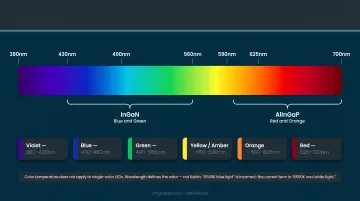
Color temperature does not apply to any of these. Single-color LEDs are defined entirely by their wavelength. Phrases like "6500K blue light" are technically incorrect — the right description is "6500K cool white light."
How White LED Light Is Produced
White light from LEDs comes from one of two approaches:
- Phosphor conversion — blue LED chip with yellow phosphor coating, common in general lighting fixtures
- RGB mixing — red, green, and blue emitters combined, standard in full-color commercial video walls
For video walls, RGB mixing is the standard. The DOE notes that RGB systems offer flexible color control but require more complex management than fixed phosphor-white sources.
Color-Tunable LED Categories
Display and architectural applications generally fall into three categories:
- Fixed white — single CCT, set at manufacturing
- White-tunable — adjustable between warm and cool CCTs (e.g., 2700K–6500K)
- Full-color-tunable — RGB/RGBA/RGBW capable of any hue
Each step up adds control flexibility but also increases system complexity. Most commercial LED video walls are full-color-tunable — white point is managed through calibration and RGB balance, not a fixed CCT setting.
Kelvin Ranges by Application
The Standard Ranges
The DOE describes the following general categories for white light:
- 1800K–2700K — warm yellow/amber, candlelight character, melatonin-supportive
- 3000K–3500K — warm white, comfortable and inviting
- 4000K–4500K — neutral white, task-friendly
- 5000K–6500K — cool white, crisp and high-visibility
- Above 6500K — intense daylight-plus, specialty applications
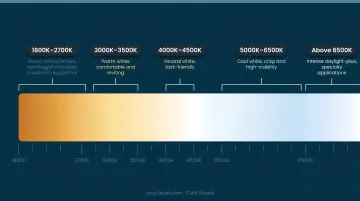
These ranges are well-established for ambient and architectural lighting. For LED video walls specifically, the picture is more nuanced.
Application Considerations for LED Video Walls
The white point of an LED video wall interacts with content, ambient lighting, and any camera systems capturing the screen. A few practical considerations:
Broadcast and production environments — Reference standards like ITU-R BT.2035 specify D65 (approximately 6500K) for HDTV reference viewing. Virtual production LED walls commonly run at native 6500K. Calibration should align with the content workflow's color space — not just a generic Kelvin number.
Houses of worship and event venues — Warmer white points flatter skin tones and create a more engaging atmosphere. The right target depends on sanctuary lighting, IMAG camera systems, and whether the display is running lyrics and graphics or live video feeds.
Corporate and boardroom environments — Neutral white points support focus and professional appearance. Ambient office lighting is a significant factor, and CMG Visuals calibrates each installation for brightness, contrast, and white point to match the specific conditions of the space.
Control rooms and task-critical environments — Accurate color assessment requires adequate color temperature. Going too warm makes it harder to evaluate content reliably; calibration relative to reference monitors is essential here.
In every case, the right white point is determined by the combination of content workflow, camera systems, and ambient lighting — not a universal default.
Color Shift Over Time
LED display color can drift over a display's lifespan due to thermal stress, component aging, and driver performance changes. DOE documents color stability (chromaticity maintenance) as dependent on temperature and drive conditions. For commercial video walls, the relevant metric is delta u'v' — a total color-difference measure — rather than a simple CCT drift rate.
When evaluating long-term display performance, ask vendors for:
- RGB-channel aging data specific to their product
- Documented recalibration provisions and service intervals
- Thermal management specifications for the installation environment
CMG Visuals sources displays directly from Tier 1 OEM manufacturers and builds thermal management into every installation — a practical step that helps prevent premature color drift.
Kelvin vs. CRI: Understanding Both Metrics
Kelvin and CRI are entirely independent measurements, and conflating them is one of the more common mistakes in display and lighting specification.
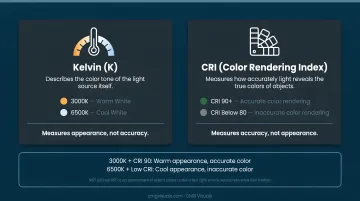
- Kelvin describes the color tone of the light source itself — warm or cool appearance
- CRI measures how accurately a light source reveals the true colors of objects compared to a reference, rated on a scale where 100 is a perfect match
NIST defines CRI as an assessment of object colors under a test light source versus reference illumination. A 3000K warm white with high CRI (90+) will look warm but still render reds, greens, and skin tones accurately. A 6500K cool white with low CRI will appear crisp but render colors inaccurately.
CRI and LED Video Walls
Spec sheets frequently blur an important distinction: CRI applies to illuminating light sources, not emissive displays.
CRI evaluates how a light source renders the colors of objects it illuminates. An LED video wall is an emissive display, producing its own light rather than illuminating surfaces. Broadcast and professional display standards use white point coordinates, chromaticity uniformity, gamut coverage, and luminance as the relevant metrics — not CRI.
For LED displays, the equivalent quality indicators are:
- Measured white point (x,y chromaticity coordinates)
- RGB channel uniformity across modules
- Color gamut coverage
- Calibration method and recalibration schedule
For ambient lighting around a display — stage wash, architectural lighting in a sanctuary, office task lighting — CRI and R9 remain relevant. When specifying a display system, apply display metrics to the screen and lighting metrics to the environment around it — not interchangeably.
Common Misconceptions About LED Color Temperature
A few persistent myths about color temperature lead to poor display decisions. Here's what the specs actually mean:
Higher Kelvin does not mean brighter. Brightness is measured in lumens or nits. A 3000K display can be significantly brighter than a 6500K display — Kelvin describes color tone, not output intensity.
"Blue light" is not the same as high color temperature. A blue LED is defined by its wavelength (~450–495nm), not its CCT. High-CCT white is still white light with a cooler tone — not a colored LED. These are different products with different specifications.
No single Kelvin value is right for every space. The appropriate white point depends on the function of the space, ambient lighting, content type, camera systems, and the audience. What works for a sports arena video wall will be wrong for an intimate event venue — and vice versa.
Frequently Asked Questions
Do LED lights affect circadian rhythm?
Yes. Blue-rich light at higher color temperatures suppresses melatonin production in the evening, disrupting sleep-wake cycles — the AMA and NIOSH have both issued guidance against prolonged exposure. Amber light in the 1800K–2700K range has the least circadian impact.
What are the different LED colors?
LED colors fall into two categories: monochromatic LEDs defined by wavelength (red, green, blue, UV, infrared, and others) and white LEDs, produced by combining a blue chip with yellow phosphor or mixing RGB emitters. White LEDs are characterized by color temperature (Kelvin); single-color LEDs are not.
What is the difference between Kelvin and CRI?
Kelvin describes the color tone of white light (warm vs. cool appearance). CRI measures how accurately a light source renders the true colors of objects on a 0–100 scale. Both metrics are needed to fully evaluate a lighting source — but for emissive LED displays, the relevant quality metrics are white point, gamut coverage, and chromaticity uniformity rather than CRI.
What color temperature is best for a broadcast studio or production environment?
Broadcast reference standards specify D65 (~6500K) white point coordinates for HDTV reference viewing, and virtual production LED walls typically run at that native setting. The specific target should align with the content workflow's color space and camera white balance — calibration to measured coordinates is more reliable than a general Kelvin number.
Can color temperature shift over time in LED displays?
Yes. LED displays can experience color drift from thermal stress, component aging, and driver changes. For commercial video walls, request channel-specific aging data and recalibration provisions — and track delta u'v' (total color difference) rather than lumen-maintenance benchmarks like L70/L80, which measure brightness, not color stability.
What does CCT mean, and how is it different from Kelvin?
CCT (Correlated Color Temperature) is the measured property — defined by the CIE as the temperature of the Planckian radiator whose chromaticity is nearest the tested spectral distribution. Kelvin (K) is the unit it's expressed in. When a spec sheet lists "6500K CCT," that's one specification: the warm-to-cool color appearance of white light, expressed in its standard unit.