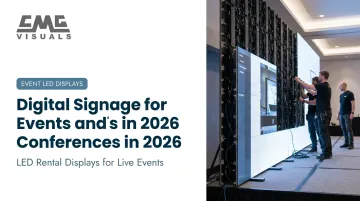
In Freeman's 2024 survey of over 2,000 in-person attendees, 45% said technology that makes an event easier to navigate directly shapes how they rate the experience, and 44% pointed to an immersive, visually engaging atmosphere as a top motivator for showing up.
For organizers and venues heading into 2026, signage isn't a back-of-house line item anymore. It's a competitive differentiator. This article breaks down the five trends reshaping event signage, what's driving them, how they're changing event planning, and where LED technology fits into the decisions ahead.
Key Takeaways
- LED video walls outperform projection in ambient light and camera capture, becoming the top stage display choice.
- AI now powers real-time schedule updates and personalized content, already adopted by 65% of event professionals.
- QR codes, social walls, and live polling turn passive screens into two-way engagement tools.
- Rental and modular LED lets organizers match display shape to venue without overbuying hardware.
- Sustainability goals and total cost of ownership are shifting AV budgets away from projectors and print.
Key Trends Shaping Digital Signage for Events & Conferences in 2026
Five shifts are redefining how organizers and venues plan event signage. Each addresses a different pressure point, from attendee expectations to sponsor ROI, but together they mark a move away from static, one-size-fits-all displays toward systems that adapt in real time.
LED Video Walls Are Replacing Projectors as the Default Display
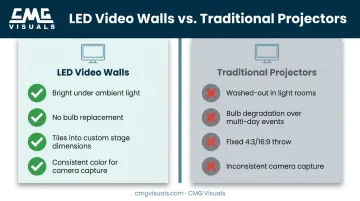
Projectors used to be the default for keynote stages because dark rooms hid their washed-out colors once the house lights came up. LED direct-view walls don't have that problem. They hold brightness and color under normal ambient light, so production teams don't have to dim a ballroom just to get a legible slide onscreen.
Practical advantages driving the switch:
- Eliminates bulb replacements and lamp degradation over a multi-day conference run
- Tile into custom stage dimensions instead of forcing a fixed 4:3 or 16:9 throw
- Deliver consistent brightness and color for camera capture, which matters more as hybrid and livestreamed sessions become standard
We saw this firsthand supplying a 161-square-foot, P2.6mm LED wall (our 101R Series) for Libsyn's booth at Podcast Movement 2025 at the Gaylord Texan in Grapevine, Texas. The screen ran sizzle reels and brand storytelling across the exhibit hall floor, elevated two feet for sightlines, something a projector setup couldn't have managed in that ambient-lit hall.
Direct-sourced, NovaStar-certified panels matter here too. Working with certified engineers and OEM-sourced hardware means venues get professional-grade brightness and resolution without paying inflated reseller markups baked into many AV rental quotes.
AI-Driven Dynamic and Personalized Content
Static digital agendas are giving way to platforms that update themselves. Modern content management systems pull from badge scans, app data, and registration details to auto-adjust what's on-screen, from session reminders to room-change alerts, without a staffer manually swapping a slide deck.
A common example: large conferences now use adaptive digital agendas that recommend sessions to attendees based on badge type or past app activity, then push that content to nearby screens or personal devices in real time.
This isn't a fringe experiment. PCMA's 2025 Meetings Market Survey found that 65% of event professionals already use AI somewhere in their planning, though only 44% of their organizations have formal AI policies in place.
That gap matters specifically for signage. Auto-updating content is only useful if someone reviews it before it hits a 20-foot screen in front of a keynote audience. Build in a human check, even as AI handles the scheduling and translation work.
Interactive and Mobile-Integrated Signage
Passive screens are becoming a hard sell for sponsors and attendees alike. Interactive signage flips that by giving people a reason to stop, engage, and stay in a sponsor zone a few minutes longer.
Common formats now showing up at conferences and trade shows:
- QR-triggered wayfinding that pulls up maps and directions on a phone
- Live social media walls pulling event-hashtag posts onto lobby screens
- Real-time polling displayed during general sessions
- Gamified leaderboards tied to booth visits or session check-ins
PCMA documented an example at a Virginia Military Institute conference, where organizers used a polling tool accessed through a QR code to run real-time surveys during technical sessions. Attendees submitted responses from their phones and saw results incorporated live into the presentation.
No specific engagement lift was reported, but the mechanism illustrates the shift: attendees expect to participate, not just watch.
Why it's growing: two-way engagement extends dwell time near sponsor-branded screens, which is exactly the kind of measurable exposure sponsors now negotiate into their packages.
Rental and Modular LED Solutions for Flexible Event Design
Committing to a fixed LED install makes sense for a venue running events every week. It makes far less sense for a one-time conference or a touring trade show booth that changes floor plans every stop.
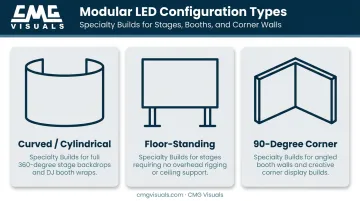
That's why rental and modular LED has become the default for event-specific signage:
- Curved and cylindrical configurations wrap stages and DJ booths for immersive, 360-degree visuals
- Floor-standing walls need no rigging or wall mounting, useful for booths without structural anchoring
- 90-degree corner displays wrap booth walls for seamless visual continuity
CMG Visuals supports this shift by offering both rental and purchase paths on the same specialty configurations, rather than forcing event teams into a fixed catalog. Rental packages for standard configurations start around $3,500, with specialty setups like curved DJ booth displays starting near $1,200 per day, depending on size and duration.
The advantage for organizers: match the display to the venue and the moment. A trade show booth that needs a corner display this quarter might need a cylindrical centerpiece next quarter, and renting modular panels means that flexibility doesn't require buying hardware that sits in a warehouse the rest of the year.
Sustainability and Total Cost of Ownership Focus
Printed schedules and signage waste are an easy target in sustainability audits, and projector bulbs add a recurring cost most organizers don't love explaining line-by-line. LED doesn't eliminate every cost, but it changes the shape of the bill.
Where the pressure is coming from:
- Corporate sponsors increasingly ask which AV vendors a venue uses before signing on, and lower energy draw factors into that decision
- Venues are running multi-year ROI comparisons between LED, projection, and print instead of pricing each event in isolation
- Fewer consumables, no bulbs, no reprints, mean fewer emergency vendor calls mid-event
At CMG Visuals, every LED display we sell carries a 5-year hardware warranty with lifetime product support, which gives venues a concrete number to plug into their own TCO math instead of guessing at replacement cycles. That kind of documented reliability increasingly determines which AV vendor gets shortlisted for a multi-year conference contract.
What's Driving These Digital Signage Trends
Several forces are converging to push signage technology forward, and the money backs it up. AVIXA's industry outlook projects the venues-and-events pro-AV segment to reach $57.2 billion by 2029, a 6.3% compound annual growth rate, the fastest-growing vertical AVIXA tracks. That growth traces back to four specific shifts:
- Technology advances: LED panel costs keep falling while brightness and resolution keep climbing. Cloud-based content management platforms let a single operator push updates across dozens of screens from a laptop.
- Market demand and attendee expectations: Hybrid events raised the bar. Attendees who've watched a broadcast-quality livestream now expect that same polish in person, and organizers who can't deliver it lose repeat bookings.
- Cost pressures and efficiency needs: Reprinting a schedule because a keynote speaker cancelled used to mean a rush order and a few hundred dollars down the drain. Updating a digital sign takes a few clicks and no reprint fee.
- Competitive dynamics: Venues differentiate on AV capability now, not just square footage or catering. A venue offering in-house LED walls and certified technicians wins the corporate rebooking a bare-bones ballroom doesn't.
How These Trends Are Impacting Events and Conferences
These shifts are changing how events are staffed, budgeted, and planned. The same PCMA survey found that 58% of event professionals name AV as a top-three budget priority, even as 30% report trimming AV spending elsewhere to afford it.
Operational Impact
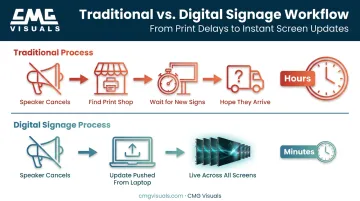
A speaker cancellation used to trigger a scramble: find the print shop, wait for new signs, hope they arrive before doors open. Now it's a content update pushed from a laptop.
- Schedule changes go live across every screen in minutes, not hours
- Emergency alerts (weather, security, room changes) reach attendees before they walk into the wrong session
- One operator can manage signage across an entire convention center instead of physically swapping posters floor by floor
Business Impact
Static sponsor banners used to be a one-time sale. Rotating digital placements change that math. A single LED wall can now carry multiple sponsor slots throughout a day, and organizers are pricing that inventory the way broadcasters price ad time, by placement, frequency, and audience size.
That shift turns screen space into a recurring revenue line instead of a one-off signage fee, and it's part of why sponsors increasingly ask what display technology a venue runs before committing budget.
Workforce Impact
Setting up an LED wall correctly (calibration, color matching, processor configuration) isn't a job for whoever's available that morning. It requires someone who understands the control system.
That's pushing organizers toward certified specialists instead of general labor. Partnering with NovaStar-certified engineers means calibration and troubleshooting happen before doors open, not during a keynote, which removes a technical burden that used to fall on whoever brought the most extension cords.
Future Signals for Digital Signage at Events Beyond 2026
These trends are already in motion. A few developments worth watching over the next one to three years will push signage further:
- Transparent and flexible LED: Samsung's CES 2024 demo hinted at see-through stage backdrops and booth designs that blend digital content into physical space instead of covering it. Still emerging, not standard event inventory yet.
- Deeper AI personalization: Expect signage that adjusts content based on individual attendee behavior pulled from app or badge data, not just segment-level scheduling.
- Growth of the rental market: Grand View Research projects the modular LED display market to roughly double by 2030. More venues may eventually build in-house display inventory instead of outsourcing every event.
Conclusion
LED walls, AI-driven content, two-way interactivity, rental flexibility, and sustainability point to one shift: event signage that adapts in real time instead of sitting static until the next print run.
Organizers who adopt these tools early give attendees a smoother experience and give sponsors a reason to pay more for screen space, both of which show up directly in repeat bookings.
Turning that potential into results starts with choosing the right display partner. If you're evaluating LED displays for an upcoming conference, working with an independent, certified partner matters more than picking the biggest screen on a spec sheet.
CMG Visuals matches display technology to your venue and budget. Whether that means a rental configuration for a single trade show or a custom-built wall for a venue hosting events year-round, the quote never includes a reseller markup.
Frequently Asked Questions
What is digital signage for events and conferences?
Digital signage covers electronic displays, LED walls, screens, and kiosks used to show schedules, wayfinding, sponsor content, and live updates instead of printed programs. It updates instantly and can be managed remotely across an entire venue.
What's the difference between LED walls and traditional projector screens for events?
LED walls stay bright under normal room lighting and skip the bulb replacements and dark-room requirement projectors need. Projectors can still work in controlled-light rooms on a lower budget, but LED holds color and brightness more consistently for cameras and hybrid streams.
Should I rent or buy an LED display for my event?
One-time conferences and touring trade shows typically get better value renting, since it avoids paying for hardware that sits unused most of the year. Venues hosting events year-round often save more by purchasing a custom modular wall built to their space.
How much does digital signage cost for a conference?
Cost depends on screen size, resolution, pixel pitch, and whether you rent or buy. Rental packages for standard configurations often start around $3,500, though the best next step is requesting a quote based on your venue's specifications.
What size LED display do I need for my venue?
Sizing comes down to room dimensions, viewing distance, and pixel pitch: finer pitch works for close viewing, and coarser pitch suits large rooms viewed from a distance. A display specialist can walk your specific room and recommend the right fit.
Can digital signage be used for wayfinding at large conferences?
Yes. Digital screens with maps, directional arrows, and room schedules help attendees navigate multi-room convention centers far faster than static printed maps, and content updates instantly if a room changes.