For LCD displays with LED backlighting, leakage means light escaping around panel edges. For true modular LED video walls, the concern shifts to seam visibility and moisture ingress. Misidentifying which problem you have leads to misapplied fixes, wasted money, and potentially permanent damage.
Whether you're managing a corporate boardroom display, a sanctuary video wall for a house of worship, or an outdoor event screen, catching the root cause early prevents costly downtime and panel replacement. This article breaks down exactly what causes each type of leakage, what happens if you ignore it, and how to prevent it.
Key Takeaways
- LCD backlight bleed and LED video wall seam/moisture issues are distinct problems with different causes and solutions
- Mild backlight bleed in dark rooms is normal; only severe or widespread bleed warrants concern
- Module-seam light on LED video walls is almost always an installation problem, not a product defect
- Outdoor LED panels must carry an appropriate IP rating for their deployment environment — IP65 minimum for fully exposed locations
- Unaddressed moisture in outdoor cabinets causes electrical shorts and line defects that can require full module replacement
Common Causes of LED Screen Light Leakage
"LED screen leakage" covers unintended light escaping past a display's intended viewing zone. What that looks like in practice depends entirely on the underlying technology.
Most causes fall into four categories: manufacturing tolerances, improper installation, environmental exposure, and component aging.
Backlight Bleed in LCD Displays with LED Backlighting
Edge-lit LCD panels place LEDs along the screen's perimeter. When the backlight module, diffusion films, or bezels don't align precisely, light escapes around the edges or corners, showing up as bright halos or clouding on dark content.
As Wacom describes it, this effect is most noticeable when viewing dark images in a dim room. A small amount is common and not a defect. Severe leakage that noticeably affects content quality during normal use is a different story.
Typical scenario:
- Visible primarily on a solid black image in a darkened room
- More pronounced at screen corners than along edges
- Often a manufacturing tolerance issue, not a functional failure
Module-to-Module Light Bleed on LED Video Walls
True LED video walls are assembled from modular cabinets. If those cabinets aren't precision-aligned during installation — or if frames are bent or improperly latched — light leaks through the seams between modules, creating visible bright lines on dark content.
Barco's research into seamless LED installations confirms that too much inter-tile space creates visible seams, while too little can cause visual inconsistency and even LED damage. Hisense's installation documentation specifies cabinet surface flatness within ±0.1 mm, with first-row bottom-cabinet flatness within 0.05 mm. Those are tolerances that require professional-grade installation — not a DIY alignment job.
Common signs:
- Most noticeable during low-brightness content playback
- Often caused by rushed installation, physical impact during transport, or mismatched cabinet batches
Moisture and Water Ingress in Outdoor LED Displays
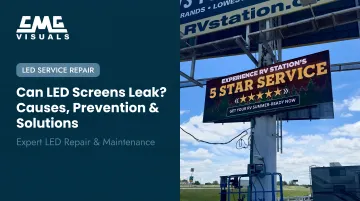
Outdoor LED panels rely on IP-rated enclosures to block moisture. When the IP rating is insufficient for the environment, or when gaskets degrade over time, water can penetrate the cabinet and cause short circuits, corrosion, or visible panel failures.
The IEC's ingress protection framework establishes clear ratings for outdoor use:
| IP Rating | Protection Level | Typical Use Case |
|---|---|---|
| IP44 | Splash-protected | Covered patios, semi-outdoor |
| IP65 | Water jet protected | Standard outdoor installation |
| IP66 | Powerful jet protected | High-exposure outdoor |
| IP67 | Temporary immersion | Near fountains or pools |
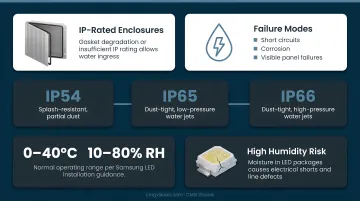
A Samsung LED installation manual notes that high humidity can introduce moisture into LED packages, causing electrical shorts and line defects. Normal operating range is specified as 0–40°C and 10–80% relative humidity.
Component Aging and Physical Damage
Foam pads, rubber seals, and adhesive tapes inside display cabinets compress and shrink over time, widening gaps that allow unintended light to pass through. Physical impacts from handling, mounting, or transport can also crack bezels or warp frames.
Watch for:
- Gradual worsening of edge bleed over months or years
- Sudden seam light appearing after a move, transport, or reconfiguration
What Happens If LED Screen Leakage Is Ignored
For corporate boardrooms, broadcast studios, and houses of worship, light leakage on dark scenes undermines professional content quality, reduces perceived contrast, and distracts audiences. These are exactly the environments that invest in premium displays to avoid those problems.
Optical leakage is only part of the risk. When moisture penetration enters the picture, the consequences escalate quickly. Electrical shorts, corroded connectors, and dead pixel clusters don't self-correct — they spread. What starts as discoloration near a panel edge can become a full module failure requiring component-level replacement.
Warning Signs You're About to Experience Leakage
Watch for these early indicators:
- Bright halos or white glow at screen edges or corners when displaying a black background in a dim room
- Visible bright lines or gaps at seams between LED cabinet modules during low-brightness content playback
- Discoloration, flickering, or dead pixel clusters near the edges of outdoor panels after rain or high humidity — a strong indicator of moisture penetration
Catching these signs early typically means a targeted module repair. Waiting until symptoms spread often means a full cabinet replacement.
How to Prevent LED Screen Leakage
Prevention comes down to two phases: decisions made before installation (choosing the right product) and actions taken during and after (setup and maintenance).
Choose the Right Display Technology for the Environment
Matching the display to the environment is the single most impactful decision you can make. Buying the wrong product for the conditions isn't something calibration can fix.
- Select outdoor LED panels rated IP65 or higher for fully exposed installations — IP44 is adequate for covered patios but insufficient for rain-exposed positions
- For indoor LED video walls, confirm that cabinet seam tolerances meet manufacturer specifications before accepting delivery
- For LCD displays in controlled environments, verify that backlight uniformity meets your application's quality standard before installation
When sourcing through CMG Visuals, panels are direct-sourced from tier-1 OEM suppliers, so spec verification happens before the product ships rather than relying on distributor claims downstream.
Ensure Professional, Precision Installation
Misaligned cabinets are the leading cause of module-seam light bleed on LED video walls. This is an installation problem, not a product problem, and correcting it after the fact costs significantly more than doing it right the first time. For LED video walls, professional installation means:
- Cabinet alignment verified on x, y, and z axes before locking modules in place
- Seam gaps inspected against manufacturer flatness tolerances
- All cabinet latches confirmed secure after assembly
- Post-installation black-screen check performed in reduced lighting to catch any visible bleed before handoff
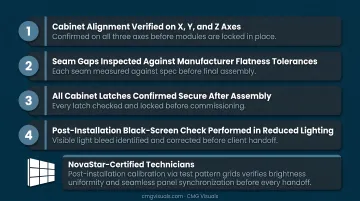
CMG Visuals' NovaStar-certified technicians perform post-installation calibration using test pattern grids to verify brightness uniformity and seamless panel synchronization, which is also when any seam irregularities are identified and corrected before client handoff.
Calibrate Backlight and Brightness Settings
, a schedule worth adopting for any commercial display regardless of brand.
Tips for Long-Term Prevention and Control
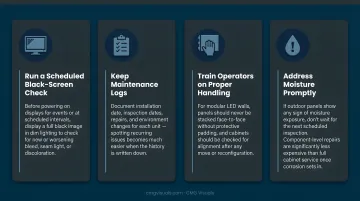
Beyond core prevention, these practices extend display lifespan and surface problems early:
- Run a scheduled black-screen check: Before powering on displays for events or at scheduled intervals, display a full black image in dim lighting to check for new or worsening bleed, seam light, or discoloration
- Keep maintenance logs: Document installation date, inspection dates, repairs, and environment changes for each unit — spotting recurring issues becomes much easier when the history is written down
- Train operators on proper handling: For modular LED walls, panels should never be stacked face-to-face without protective padding, and cabinets should be checked for alignment after any move or reconfiguration
- Address moisture promptly: If outdoor panels show any sign of moisture exposure, don't wait for the next scheduled inspection. Component-level repairs are significantly less expensive than full cabinet service once corrosion sets in.
Conclusion
LED screen leakage has identifiable causes rooted in manufacturing tolerances, installation quality, and environmental exposure. With the right knowledge at each stage, none are difficult to anticipate or prevent.
Backlight bleed in LCD displays is largely a function of panel construction and setup. Module-seam light in LED video walls is almost always an installation issue. Moisture ingress is an enclosure and environment-matching problem. Each type has a defined fix: better panel selection, tighter installation tolerances, or the right IP rating for the environment.
For organizations running corporate boardrooms, broadcast studios, worship environments, or outdoor event screens, the cost of prevention is a fraction of the cost of damage control. Proper product selection, professional installation, and routine inspection protect the display investment long-term — and keep visual quality at the standard these environments demand. That's exactly where working with a qualified integrator — one who specs the right display for the environment from the start — makes the difference between a screen that performs for years and one that creates ongoing problems.
Frequently Asked Questions
What does an LCD leak look like?
LCD leakage appears as bright patches, halos, or a glow at the screen's corners or edges when displaying a dark or black image — most visible in dim lighting. It doesn't involve any liquid physically leaking out, and it looks very different from a cracked screen.
Should I worry about backlight bleed?
Mild backlight bleed visible only in dark environments is considered normal and within industry tolerances for most LCD panels. If the bleed is visible under standard office or room lighting, or it meaningfully affects content quality during normal use, get the panel evaluated by your display provider.
Is LCD liquid leak toxic?
"LCD leak" typically refers to light leakage, not physical liquid. If a screen is physically cracked and the liquid crystal material is exposed, avoid contact, wash hands thoroughly, and handle the panel carefully — liquid crystal materials can be mildly irritating to skin.
Do true LED video walls experience the same type of light leakage as LCD screens?
No. LG Business confirms that true direct-view LED eliminates the LCD panel and requires no backlight — so backlight bleed as defined for LCD screens doesn't apply. LED video wall concerns are module-seam visibility from misaligned cabinets and moisture ingress in outdoor installations.
Can LED screen light leakage be fixed without replacing the panel?
In many cases, yes. Module-seam bleed on LED video walls can often be corrected by re-aligning or re-latching cabinet modules. Mild LCD backlight bleed can be mitigated through brightness adjustments. Moisture-damaged panels may require component-level replacement (hub boards, receiving cards, or individual modules) based on the extent of the damage.