Introduction
Walk into an office or retail space after a few years, and you might notice something off about the lighting — a warm, yellowish cast where clean white light used to be. It's a gradual change, easy to overlook until it becomes obvious. But by the time yellowing is visible to the naked eye, the underlying material degradation is already well underway.
LED panel lights turn yellow for specific, identifiable reasons: heat stress on phosphor coatings, UV radiation breaking down optical materials, light guide plate degradation, and environmental contamination. Each cause has a clear explanation — and each is preventable with the right decisions at the procurement and installation stage.
This guide breaks down each cause, explains how to recognize early warning signs, and outlines what to do — before and after installation — to keep panels performing as intended.
TL;DR
- Yellowing results from phosphor coating degradation, UV exposure, light guide plate (LGP) material breakdown, and environmental contamination
- Edge-lit panels using PS (polystyrene) LGPs yellow faster than backlit designs or those using PMMA (acrylic) plates
- Internal phosphor or LGP degradation is permanent — prevention is the only reliable strategy
- Early signs include a subtle warm tint in previously cool-white output, a yellowish center patch, and gradual dimming
- Verified manufacturers with documented material specs are your best defense against premature yellowing
Common Causes of LED Panel Light Yellowing
Yellowing in LED panel lights describes a visible shift in emitted light — from cool or neutral white toward a warm yellow or amber tone. It's most common in edge-lit flat panel designs, though any panel can be affected under the right conditions.
The causes rarely operate in isolation. Heat, UV, material quality, and environmental exposure interact and compound each other over time.
Heat Exposure and Phosphor Degradation
LED panels generate heat during normal operation. The phosphor coating on each LED chip — which converts blue LED light into white light — is sensitive to sustained heat. When that coating degrades, the conversion process becomes uneven, shifting color output toward yellow.
DOE research on LED luminaire color shift identifies phosphor degradation, package-resin discoloration, and optical material breakdown as distinct but related failure mechanisms — all accelerated by elevated operating temperatures.
Heat buildup is most problematic in:
- Panels installed in enclosed ceiling cavities with no airflow above
- Retail or office fixtures running at maximum brightness for extended hours
- Panels without aluminum heat sinks or adequate thermal management built in
Each manufacturer specifies its own ambient operating range — Signify's EvoKit panel, for example, is rated L70 ≥ 54,000 hours at 35°C. That figure shifts significantly as ambient temperature rises, which is why installation environment matters as much as the fixture itself.
UV Radiation Exposure
UV radiation accelerates the chemical breakdown of both phosphor coatings and plastic diffuser materials. Research on UV effects on synthetic materials identifies solar UVB (280–315 nm) and UVA (315–400 nm) as the primary polymer-degradation bands — the same wavelengths that bleach plastics and degrade coatings over time.
High-risk scenarios include:
- Panels installed near skylights or large south-facing windows
- Commercial spaces with significant natural light penetration
- Event or broadcast settings where panels operate alongside high-intensity UV light sources
In spaces where both UV exposure and heat are present, these failure modes reinforce each other — speeding up what either factor would cause alone.
Light Guide Plate Material Degradation
In edge-lit panel designs, a light guide plate (LGP) routes light from side-mounted LEDs evenly across the panel face. The material used for this plate is the single most important variable in predicting yellowing.
The two dominant materials:
| Material | Cost | UV/Weather Resistance | Yellowing Risk |
|---|---|---|---|
| PS (Polystyrene) | Lower | Poor | High — yellows and embrittles under UV exposure |
| PMMA (Acrylic) | Higher | Significantly better | Lower under equivalent conditions |
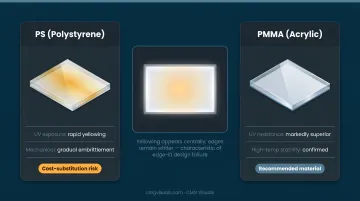
Polymer photodegradation research confirms that polystyrene exposed to UV undergoes rapid yellowing and gradual embrittlement — a well-established materials science finding. PMMA performs markedly better in high-temperature and UV-exposed conditions.
The practical problem is that manufacturers cutting costs often substitute PS for PMMA without disclosure. Yellowing from LGP degradation typically appears as a yellow patch in the panel's center, while edges remain whiter — a recognizable sign of edge-lit design failure.
Environmental Contamination
Beyond material and thermal failure, the surrounding environment plays its own role. Panels are not sealed systems — moisture, chemical vapors, airborne grease, and fine dust infiltrate interiors through housing gaps over time, degrading the diffuser plate and LGP from the inside.
Environments with elevated risk:
- Commercial kitchens (grease vapor, heat, moisture)
- Bathrooms and humid corridors
- Laboratories or facilities with chemical off-gassing
External buildup adds another layer to the problem. Dust and grime on the diffuser surface create a yellowing film that's visible even when internal components are intact.
What Happens If LED Panel Yellowing Is Ignored
Leaving yellowing unaddressed creates a cascade of operational problems:
- Reduced lumen output forces brightness settings higher, which accelerates further degradation — a self-reinforcing cycle
- Color accuracy deteriorates, which directly affects spaces where accurate color rendering matters: retail display, art, broadcast, medical, and food service environments
- Uneven brightness worsens over time as localized degradation spreads
- Full panel failure becomes unavoidable, with unplanned replacement costs replacing what could have been a managed maintenance cycle
DOE FEMP guidance recommends initiating replacement planning when luminaire output falls 25% below initial levels — a threshold yellowed panels often reach earlier than expected due to compounding degradation mechanisms.
Warning Signs You're About to Experience Yellowing
Yellowing doesn't appear overnight. These early indicators signal material stress before discoloration becomes visible:
- Subtle warm or amber tint in light previously calibrated to cool or neutral white (4000K–6500K), most noticeable when comparing panels side-by-side
- Yellowish center patch forming on the panel face while edges remain whiter — a hallmark of LGP degradation in edge-lit designs
- Gradual brightness drop without any setting changes, often paired with slightly elevated surface temperatures on the fixture housing
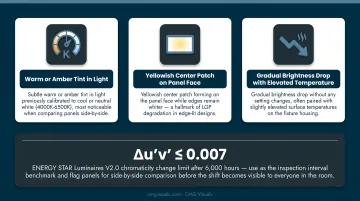
ENERGY STAR Luminaires V2.0 used a chromaticity change limit of Δu'v' ≤ 0.007 after 6,000 hours as a qualification benchmark. Facilities teams can use that benchmark to set inspection intervals and flag panels for side-by-side comparison before the shift becomes visible to everyone in the room.
How to Prevent LED Panel Lights from Turning Yellow
Prevention is a layered approach: procurement decisions, installation practices, and ongoing maintenance all contribute. No single fix covers all risk vectors.
Proper Ventilation and Heat Management
Heat is the most controllable factor in phosphor degradation. During installation:
- Ensure adequate clearance above and around the panel — avoid sealed ceiling cavities
- Use fixtures with built-in aluminum heat sinks
- Check that the installation environment falls within the manufacturer's specified ambient temperature range for that specific product
- For high-output or continuously operated installations, consider supplemental airflow
Running panels at 80% brightness during low-traffic periods reduces heat generation without compromising usable light levels.
UV Protection Measures
For panels in UV-exposed locations:
- Apply UV-filtering window film to adjacent glazing — commercial window films can block significant UV transmission
- Position panels away from direct sun paths where layout allows
- Specify UV-stable diffuser materials when ordering, and request confirmation from the manufacturer
UV protection operates at two levels: architectural (window treatment) and component (material specification). Addressing both gives you the best shot at long-term color stability.
Select Quality Materials and Panel Type
The most impactful decisions happen before installation — at the specification and procurement stage.
Backlit vs. edge-lit: Backlit LED panels eliminate the light guide plate entirely. Since LGP degradation is the most common root cause of yellowing complaints, removing that component removes that failure pathway. When backlit is a viable design option, it's worth specifying.
When edge-lit is required:
- Specify PMMA light guide plates explicitly — not just "acrylic-class" materials
- Request material data sheets from manufacturers before purchase
- Verify that the documented LGP material matches what's actually in the product
Supplier documentation doesn't always match what ends up in the product. Requesting third-party material verification or working with integrators who maintain direct OEM relationships adds a layer of accountability that catches substitutions before they reach the field.
Certifications to look for:
- ENERGY STAR Luminaires V2.0 (includes 6,000-hour color maintenance requirements)
- DLC SSL V6.0 qualification (2025 requirements)
- LM-80/TM-21 data for LED sources at stated operating temperatures
One important caveat: LM-80 certification covers LED source performance only. It does not test LGP or diffuser UV aging. For those components, require material-specific weathering data separately.
Regular Cleaning and Maintenance
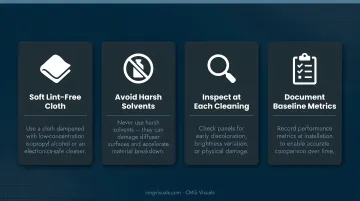
Surface contamination compounds internal degradation. A basic cleaning protocol:
- Use a soft, lint-free cloth dampened with low-concentration isopropyl alcohol or an electronics-safe cleaner
- Never use harsh solvents — they can damage diffuser surfaces and accelerate material breakdown
- Inspect panels at each cleaning for early discoloration, brightness variation, or physical damage
- Document baseline performance metrics at installation to enable accurate comparison over time
Tips for Long-Term Prevention and Control
For facility managers and AV operators responsible for ongoing LED panel installations, these habits reduce long-term yellowing risk:
- Establish a quarterly inspection schedule — check for color shift, brightness loss, and surface discoloration across all panels; compare against baseline measurements taken at installation
- Specify IP-rated enclosures based on actual environmental exposure — in spaces with moisture, humidity, or chemical vapors, work with your supplier to identify the appropriate ingress protection classification per IEC 60529 rather than defaulting to a standard indoor panel
- Require material data sheets when specifying new installations — confirm LGP type (PMMA vs. PS) and phosphor coating specifications in writing before purchase; this protects against undisclosed cost-cutting substitutions
- Avoid continuous maximum brightness operation — dimming to 80% during low-traffic periods meaningfully reduces heat accumulation and slows material aging without compromising functional light levels
- Log any early warning signs during inspections — a written record of when warm tinting or center patches first appear helps distinguish gradual degradation from sudden component failure and supports repair-vs-replace decisions
Conclusion
LED panel light yellowing isn't a mystery. It follows directly from heat stress degrading phosphor coatings, UV radiation breaking down optical materials, light guide plate material failure, and environmental contamination working their way into the fixture interior. Each mechanism is identifiable, and each is preventable.
The most cost-effective approach is making the right decisions before panels go on the wall:
- Specify PMMA over PS light guide plate material
- Choose backlit over edge-lit where thermal conditions allow
- Require material documentation from suppliers before purchase
- Install with heat dissipation pathways in mind
- Schedule routine cleaning and early warning monitoring post-installation
Reactive replacement is expensive and disruptive. The panels that last are the ones specified correctly from the start — not rescued after the yellowing has already set in.
Frequently Asked Questions
Why do LED panels go yellow?
Yellowing results from a combination of heat-induced phosphor coating degradation, UV radiation breaking down diffuser and LGP materials, and light guide plate material deterioration over time. Low-quality PS-based panels are the most susceptible because polystyrene has poor UV and weather resistance compared to PMMA alternatives.
Can yellowed LED panels be fixed, or do they need to be replaced?
Surface yellowing from dust or grease accumulation can sometimes be resolved with cleaning. Internal phosphor degradation or LGP material change is permanent — no cleaning or recalibration reverses it. In most cases, once internal yellowing is visible, full panel replacement is the only effective solution.
Does the type of LED panel (backlit vs. edge-lit) affect yellowing?
Yes, significantly. Edge-lit panels contain a light guide plate — the primary yellowing failure point. Backlit panels eliminate the LGP entirely, removing that degradation pathway. Backlit designs carry lower yellowing risk over the long term.
How long do LED panel lights typically last before turning yellow?
It depends on material quality and operating conditions. PMMA-based panels in properly ventilated spaces maintain color stability longer than PS-based alternatives, which can yellow noticeably earlier in high-UV or high-heat environments. No universal lifespan applies — check manufacturer-specific L70 data and material specifications before purchasing.
What is the best light guide plate material to prevent yellowing?
PMMA (polymethyl methacrylate) far outperforms PS (polystyrene) in UV and weather resistance. When specifying edge-lit panels, require written confirmation of PMMA construction and, where available, request weathering test data for the specific grade used.
Can LED lights cause dizziness?
Yellowing itself doesn't cause dizziness, but poor-quality LED panels with high flicker rates can cause visual discomfort. IEEE 1789-2015 addresses flicker-related health risks, and quality manufacturers report panel-level metrics like PstLM and SVM. Selecting panels with low flicker and appropriate color temperature resolves this concern independently of yellowing.