Introduction
Choosing between neon and LED signs isn't as straightforward as it looks. Both produce eye-catching illumination, both can be custom-shaped, and both show up in everything from corner bars to corporate lobbies. But they work completely differently, and picking the wrong one can mean higher energy bills, unexpected repair costs, or a sign that doesn't hold up in the environment you need it for.
The stakes are real. A traditional neon sign in a high-traffic outdoor setting becomes a fragile liability. An LED sign in a vintage speakeasy might feel clinical and cold. Getting the match right pays off for years; getting it wrong is an expensive lesson.
This guide breaks down both technologies across the factors that matter most — construction, cost, energy use, lifespan, and design flexibility — so you can make a confident decision for your specific situation.
Key Takeaways
- Traditional neon uses gas-filled glass tubes; LED signs use semiconductor diodes — similar appearances, very different technology
- LED signs draw far less power and typically last 50,000+ hours — compared to 10,000–15,000 for traditional neon
- Neon wins on vintage, handcrafted aesthetic in controlled indoor settings; LED wins on nearly every operational metric
- Many signs marketed as "neon" today are actually LED neon flex — worth knowing before you evaluate cost or longevity claims
- For dynamic messaging, outdoor use, or large-format displays, LED is the stronger long-term investment
Neon vs LED Signs: Quick Comparison
Here's how traditional neon and LED signs compare across the factors that actually drive the decision:
| Factor | Traditional Neon | LED Signs |
|---|---|---|
| Power source | High-voltage transformers (1,000–15,000V) | Low-voltage DC (12V–24V) |
| Core material | Hand-bent glass tubes + noble gases | Semiconductor diodes in acrylic/PVC |
| Energy draw | Higher — ~68.1W (white neon) vs. ~24.0W (white LED)* | Lower — ~210 kWh/year savings at 12 hrs/day* |
| Lifespan | Glass tubes and transformers: 8–15 years under favorable conditions | 50,000+ hours for commercial sign lighting; up to 100,000 hours for video walls |
| Design flexibility | Fixed color, static glow | Programmable color, animation, scrolling text |
| Maintenance | Requires specialist craftspeople | Modular — a failed diode doesn't take down the whole sign |
| Safety | High-voltage; argon-based colors contain mercury | Low-voltage, mercury-free; acrylic housing resists shattering |
| Best for | Decorative indoor, vintage aesthetic | Outdoor, commercial, dynamic content, large-format |
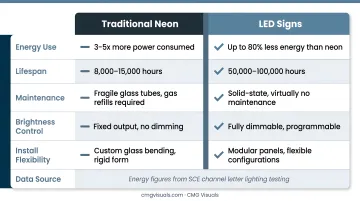
*Energy figures from SCE channel letter lighting testing.
What Are Neon Signs?
Traditional neon signs are a craft. Glass tubes are hand-bent into shapes, filled with noble gases — pure neon for red-orange hues, argon with mercury and phosphor for other colors — then sealed and wired to a high-voltage transformer. When current flows, the gas excites and emits that characteristic continuous warm glow. Every bend, every color, every curve requires a skilled glassblower. You're buying something made by hand, not stamped out by a machine.
The Aesthetic Case for Neon
That handcrafted quality is hard to replicate. The soft, slightly imperfect warmth of a real neon tube carries an authenticity that LEDs — however well-designed — haven't fully matched. Bars, tattoo studios, vintage retailers, and art installations often lean into this deliberately. The sign isn't just functional; it is the brand statement.
The Practical Limitations
For business decision-makers, the operational reality matters just as much as the aesthetics:
- High operating voltage (transformers reaching up to 15,000V) introduces shock risk; OSHA records a fatal incident involving a 15,000V neon transformer
- Mercury content in most non-red colors (the EPA-hosted IMERC fact sheet estimates 250–600mg per bulb) means disposal falls under federal Universal Waste regulations
- Glass fragility increases breakage risk — documented failure modes include pressure loss causing tubes to go flat, transformer tar leakage, and moisture-related arcing
- Repair requires specialists — not your in-house maintenance team
Where Neon Works Best
Neon makes the most sense in controlled indoor environments where the aesthetic is the point: bars, cafés, boutiques, tattoo studios, photography studios, and art installations. If the warm, imperfect glow is part of what you're selling — the atmosphere, the nostalgia, the handmade quality — neon earns its higher price and maintenance burden.
The LED Neon Flex Confusion
One important clarification: many signs sold today as "neon" are actually LED neon flex — low-voltage LED strips inside bendable polymer tubing, designed to mimic the neon look. Products like SloanLED's FlexiBRITE run on 24VDC and contain no gas or glass. They're not traditional neon, and Signs of the Times has noted the category as a distinct product type. When comparing costs, confirm which technology you're actually buying.
What Are LED Signs?
LED signs work through semiconductor diodes that emit light when electrical current passes through them. No gas, no glass tubes, no high-voltage transformer. The result is a more durable, more versatile, and more controllable light source.
The LED sign category is broad — and that breadth is part of what makes it so useful for commercial applications.
The LED Spectrum
LED technology spans a wide range of formats:
- LED neon flex — bendable strips in polymer tubing that mimic traditional neon; runs on 12–24VDC
- Backlit channel letters — individual illuminated letters for storefronts and building signs
- Programmable message boards — scrolling text and dynamic content for retail and outdoor use
- LED video walls — modular, seamless displays used in corporate lobbies, broadcast studios, event venues, and houses of worship
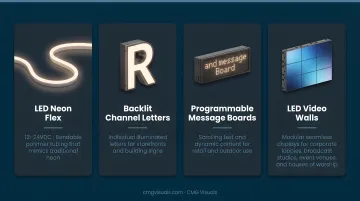
The formats differ in scale and application, but every one of them operates on the same fundamental advantages over neon.
Operational Advantages
- Low-voltage operation — 12V or 24VDC systems vs. neon's 1,000–15,000V
- Modular construction — one failed diode doesn't take down the sign; individual modules can be swapped
- Weather resistance — shatter-resistant materials handle outdoor conditions that would destroy glass neon
- No toxic materials — mercury-free, covered by no hazardous waste disposal regulations
- Minimal specialist labor — most maintenance is straightforward without neon's craft requirements
Design and Programming Capabilities
This is where LED genuinely has no competition from neon. For any business that updates messaging regularly, that flexibility is the real differentiator:
- Change colors and animations on demand
- Scroll text or display full imagery
- Integrate with digital content management systems
- Update seasonal promotions, menus, or event schedules without touching the sign physically
When LED Scales Up
For organizations that need to go well beyond basic signage, LED technology scales into territory neon can't touch. CMG Visuals works with organizations across Dallas-Fort Worth and nationwide on exactly this kind of build — from P0.9mm fine-pitch indoor video walls for corporate boardrooms to large-format displays for broadcast studios, event stages, and houses of worship. Their NovaStar-certified engineers handle configuration, calibration, and long-term support in-house. For clients running high-frequency content across multiple display zones, that turnkey approach eliminates the coordination gaps that tend to surface with multi-vendor setups.
Neon vs LED: Which Is Better for Your Business?
There's no universal answer. The right choice depends on your aesthetic intent, location, how often you need to update messaging, and your budget over a multi-year horizon.
Choose Neon If:
- Your brand identity is built around vintage, retro, or handcrafted aesthetics
- The sign is for a controlled indoor environment (bar, café, boutique, studio)
- You want a statement art piece rather than functional informational signage
- Long-term maintenance costs are acceptable given the design payoff
- You don't anticipate needing to change the message or design
Choose LED If:
- You need outdoor signage that holds up in weather and remains visible in daylight
- You require dynamic, changeable messaging (promotions, events, menus)
- You're managing multiple locations or large display surfaces
- Safety and environmental compliance are priorities — no mercury, no high-voltage exposure
- You want the lowest total cost of ownership over a 5–10 year horizon
The Cost-of-Ownership Argument
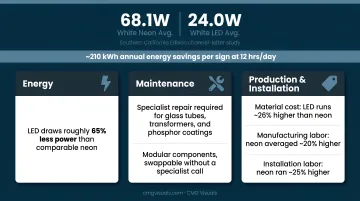
The energy data tells a clear story. A Southern California Edison channel-letter comparison found white neon averaged 68.1W versus 24.0W for white LED, translating to roughly 210 kWh in annual energy savings per sign at 12 hours of daily operation. Across multiple signs or a 5–10 year timeline, that gap widens fast.
Three cost categories consistently favor LED:
- Energy: LED draws roughly 65% less power than comparable neon, compounding into significant savings at scale
- Maintenance: Traditional neon requires specialist repair for glass tubes, transformers, and phosphor coatings; LED components are modular and swappable without a specialist call
- Production and installation: The same SCE study found LED material costs run about 26% higher than neon, but neon manufacturing labor averaged 20% higher and neon installation labor ran 25% higher — making the upfront cost difference narrower than most assume
The Scalability Gap
Neon tops out at decorative signage. LED technology scales from a single branded sign to a full video wall ecosystem, the kind of solution CMG Visuals has delivered for clients including the Houston Sports Authority, Blaze Media, and the Arlington Renegades.
If you anticipate expanding your visual display footprint, LED is the only format that grows with you.
Conclusion
Neon and LED serve genuinely different purposes. Neon wins on vintage aesthetic and handcrafted character — for the right interior application, it's still a compelling choice. LED wins on every operational metric that matters: energy efficiency, lifespan, design flexibility, safety, and scalability.
For most commercial applications — outdoor visibility, dynamic content, low maintenance, or anything beyond a single decorative sign — LED is the smarter long-term investment.
If you're evaluating LED display solutions for a corporate environment, event venue, house of worship, or broadcast studio, CMG Visuals can help you identify the right configuration for your space and goals. Reach out at sales@cmgvisuals.com or call 214.714.2153.
Frequently Asked Questions
How can I tell if a sign is LED or neon?
Traditional neon produces a soft, warm, continuous glow and often emits a faint buzzing sound. LED signs are brighter, completely silent, and show more uniform light distribution. Up close, glass neon has visible tube bends and slight imperfections; LED neon flex has a cleaner, seamless look on an acrylic backing.
Is neon better than LED for signs?
Neon is better for a specific aesthetic — warm, vintage, handcrafted — in controlled indoor settings where that look is the point. For outdoor visibility, changeable messaging, lower operating costs, and longer lifespan, LED is the stronger choice for most commercial applications.
Do neon signs last longer than LED signs?
No. Commercial LED sign lighting is rated at 50,000+ hours, with LED video wall systems reaching up to 100,000 hours to half brightness. Traditional neon glass tubes typically last 8–15 years, with additional lifespan losses from gas pressure degradation and transformer wear.
Are LED signs more energy-efficient than neon signs?
Yes. In Southern California Edison's channel-letter comparison, white LED averaged 24.0W versus 68.1W for white neon — generating approximately 210 kWh in annual savings at 12 hours of daily operation per sign. The gap widens with extended operating hours or multiple signs.
Can LED signs replicate the look of neon?
LED neon flex signs are visually indistinguishable from traditional neon to most viewers at a distance. However, the subtle warmth and organic imperfections of hand-bent glass neon remain unique to the traditional format — purists and design-focused clients viewing it up close in the right light will still tell the difference.
Which type of sign is safer: neon or LED?
LED signs are safer. They operate on low-voltage DC power (12–24V), contain no mercury, are built with shatter-resistant materials, and emit minimal heat. Traditional neon transformers operate at up to 15,000V, and non-red neon colors contain mercury — regulated as hazardous waste under EPA Universal Waste rules.