Introduction
Walk into a church sanctuary, a corporate boardroom, or a broadcast studio today, and you'll likely see one of two display technologies doing the heavy lifting: an LED wall or a projector.
Both can fill a room with images and command a crowd's attention. But they solve very different problems.
Choosing wrong isn't just a minor inconvenience. It affects your budget, your maintenance calls, and whether your audience can actually see what's on screen.
As of 2018, an estimated 250,000 U.S. churches still relied on projection technology. Many now face the same dim-image, bulb-replacement frustrations that drive organizations toward LED.
This guide breaks down the real differences in cost, brightness, lifespan, and flexibility, so you can pick the right technology for your venue.
Key Takeaways
- LED walls deliver self-emitting brightness and hold up in daylight or high-ambient-light rooms
- Projectors cost less upfront and pack up easily for temporary or touring events
- Expect tens of thousands of hours of panel life, needing far less maintenance than projectors.
- Base your choice on venue lighting, budget structure, and permanence needs, not brand preference.
LED Wall vs Projector: Quick Comparison
Here's a side-by-side snapshot of how these two technologies stack up:
| Factor | LED Wall | Projector |
|---|---|---|
| Cost | Higher upfront investment; lower cost over time | Lower purchase price; recurring bulb and calibration costs |
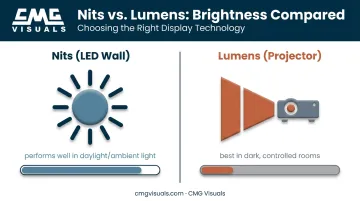
| Brightness | Measured in nits; strong in daylight and ambient light | Measured in lumens; best in dark, controlled rooms |
| Lifespan | Rated for tens of thousands of hours, minimal degradation | Lamps degrade steadily and need replacement every few thousand hours |
| Installation | Professional install required; modular and shape-flexible | Quick setup; highly portable |
| Viewing Angles | Consistent color and brightness at wide angles | Quality drops off-axis or at extreme angles |
The brightness gap deserves a closer look. Nits and lumens measure light differently: nits measure light emitted directly from the screen, while lumens measure light projected onto a surface. That distinction is exactly why LED walls hold their punch in a sunlit lobby while projectors wash out.
Practical takeaway: if your space has any ambient light, or you need the display running for years without a bulb-replacement schedule, the math starts favoring LED pretty quickly.
What is an LED Wall?
An LED wall is a modular display built from individual panels, or tiles, that lock together into one seamless screen. Unlike a projected image, every pixel generates its own light. That's why LED walls hold up in bright sanctuaries, retail storefronts, and outdoor plazas where a projected image would simply disappear.
For control rooms, broadcast studios, and retail displays running 24/7, that self-emitting design also means less strain on the hardware compared to older display technologies, translating into fewer replacement cycles and less downtime.
Variations Worth Knowing
Not all LED walls are built the same. Key distinctions include:
- Indoor vs. outdoor panels - outdoor units are weatherproofed and pushed to much higher brightness levels
- Pixel pitch - the distance between diodes; tighter pitches (like P0.9 or P1.5) suit close viewing, wider pitches (P6 and up) suit distant viewing like arenas or highway signage
- Specialty formats - curved, transparent, and flexible LED panels for architectural or creative installs
One common pitfall: buyers assume all LED panels are interchangeable. They're not. Panel quality, processor compatibility, and warranty terms vary widely between suppliers. Direct-sourced, NovaStar-certified panels with strong hardware warranties help buyers sidestep the quality and support gaps that plague cheaper, distributor-sourced alternatives. CMG Visuals backs every panel it sells with a standard 5-year hardware warranty and lifetime product support.
Use Cases of LED Walls
LED walls have become the default choice in several environments:
- Houses of worship - sermon slides and lyric displays that stay legible under sanctuary lighting
- Broadcast and production studios - virtual sets requiring consistent, camera-friendly brightness
- Corporate lobbies and boardrooms - always-on branding and presentation screens
- Tradeshow booths and sports venues - high-impact visuals visible from a distance and wide angles
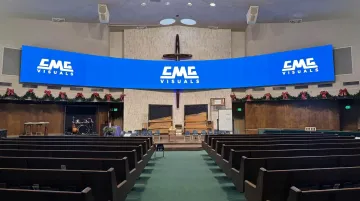
Christ United Methodist Church in Farmers Branch, Texas, is a good example. Their sanctuary previously relied on a projector mounted above the altar, an image that grew dimmer and less legible as ambient light shifted throughout services. CMG Visuals replaced it with dual P1.9 fine-pixel-pitch LED walls totaling 151 square feet, solving the visibility problem the projector couldn't.
What is a Projector?
A projector casts light through a lens onto a screen or surface to create an image. It's the go-to choice for classrooms, small conference rooms, home theaters, and any setup that needs to move locations frequently.
The appeal is straightforward: lower upfront cost, easy transport, and the ability to produce a large image from a device that fits in a backpack. For budget-conscious buyers or touring productions, that combination is hard to beat.
Variations Worth Knowing
Projector technology has evolved well beyond the classic lamp-based unit:
- Lamp-based - the traditional (and cheapest) option, but with the shortest bulb life
- LED-based - longer-lasting light source with lower brightness ceilings
- Laser - premium option with extended lamp life and better color consistency
- Short-throw and ultra-short-throw - designed for tight spaces where the projector sits close to the screen
Use Cases of Projectors
Projectors still make sense in several specific scenarios:
- Huddle rooms and classrooms - controlled lighting and modest budgets
- Pop-up events - short-term setups that don't justify a permanent display
- Projection mapping - artists and brand activations use projection to wrap light around building facades and other unconventional surfaces
- Home theaters - dark rooms where lumens go a long way
A projector's biggest strength is adaptability to temporary or creative environments. Its biggest weakness shows up the moment ambient light enters the room or the bulb starts to fade.
LED Wall vs Projector: Which One Should You Choose?
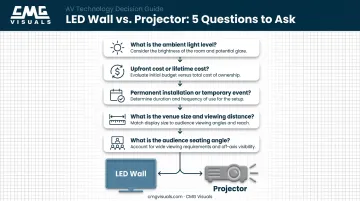
The decision boils down to five questions:
- How much ambient light does the room get? Bright, sunlit, or variable lighting favors LED.
- What does your budget look like? Lower upfront cost points to a projector; lower lifetime cost points to LED.
- Is this a permanent installation or a one-time event? Permanence favors LED; temporary use favors projectors.
- How large is the venue? Big rooms and long viewing distances favor LED's brightness and wide viewing angles.
- Where will your audience be sitting? Off-angle seating suffers more with projectors.
Christ UMC's transition illustrates this well. Before the switch, the sanctuary dealt with washed-out images and inconsistent visibility as sunlight moved across the room throughout the day, a problem no amount of bulb replacement could fully fix. The church also needed a solution that wouldn't require tearing into finished walls.
CMG Visuals engineered a custom cantilever mounting system for the dual P1.9 LED walls, preserving the sanctuary's existing structure while delivering a 7,680Hz refresh rate and full 1080p resolution on each screen. The result: consistent brightness regardless of ambient light, and zero recurring bulb costs going forward.
Christ UMC's case reflects a broader pattern: variable light and permanence tip the scale toward LED. Weigh your own venue against these same factors.
Choose a projector if:
- Your budget is tight and the room stays dark
- The display is temporary or needs to travel
- Your audience sits mostly head-on, with minimal off-angle viewing
Choose an LED wall if:
- Ambient light is a factor
- You want a permanent, high-impact display
- You need a custom shape or size
Every venue is different, and pixel pitch, mounting constraints, and budget structure all shift the calculation. That's where a consultation with CMG Visuals' NovaStar-certified engineers makes sense. They'll walk through your specific lighting, layout, and budget before recommending a direction.
Conclusion
Neither LED walls nor projectors win this comparison outright. LED walls dominate in bright, permanent, high-visibility settings where lifetime cost and consistent brightness matter more than the initial price tag. Projectors remain the practical, portable choice for controlled-light rooms, temporary events, and creative applications like projection mapping.
The real question centers on fit: which technology matches your venue's lighting, your budget structure, and how long the display needs to stay in place. Get that match right, and you'll spend less time worrying about maintenance and more time focused on what's on screen. If a permanent LED wall fits your space, CMG Visuals can help design the right configuration.
Frequently Asked Questions
Which is better: LED display or projector?
It depends on ambient lighting, budget, and permanence. LED walls excel in bright or large venues, while projectors suit small, budget-friendly, controlled-light setups.
How much does an LED wall cost compared to a projector?
LED walls carry higher upfront costs, but they typically deliver a lower total cost of ownership over time thanks to fewer replacements and less maintenance.
Do LED walls perform better than projectors in daylight or bright rooms?
Yes. LED walls' self-emitting brightness outperforms projectors in ambient or bright-light conditions, where projected images tend to wash out.
How long do LED walls last compared to projector bulbs?
LED panels are commonly rated for around 100,000 hours with minimal brightness loss, while projector lamps need replacement every few thousand hours.
Can a projector be used outdoors the way an LED wall can?
Not really. Projectors struggle outdoors due to sunlight interference, while outdoor-rated LED walls are engineered specifically for full-sun visibility.
Is it cheaper to rent an LED wall or a projector for a one-time event?
Projectors are usually cheaper to rent for small, controlled-light events. For large or outdoor events needing brightness and visibility, LED wall rental costs often pay for themselves in impact.