The confusion is legitimate — and consequential. Choose the wrong technology and you'll either overspend on resolution you can't see, or under-spec brightness for a space that needs it.
This guide cuts through the terminology. You'll learn exactly what Direct View LED is, how it works, which specs actually matter, how it compares to LCD and projection, and how to match the right display to your specific space.
Key Takeaways
- Direct View LED uses LEDs as the actual pixels — not a backlight behind an LCD panel
- Modular construction means no bezels, no fixed size limits, and front-accessible servicing
- Pixel pitch, brightness, and refresh rate are the three specs that drive most purchase decisions
- DVLED outperforms LCD and projection on contrast, brightness, lifespan, and scalability
- Matching specs to your environment requires knowing viewing distance, ambient light, and content type
What Is Direct View LED?
Direct View LED (DVLED) is a display technology where LEDs serve as the pixels themselves. Each pixel consists of a red, green, and blue LED that emits light independently to produce a full-color image. No LCD panel, no backlight layer, no projection surface — the LEDs form the image directly.
The term "LED" is badly overloaded in the display industry, which creates real confusion for buyers.
The Naming Confusion Explained
When a TV manufacturer says "LED display," they almost always mean an LED-backlit LCD panel. The LEDs sit behind or along the edge of a glass panel and illuminate a liquid crystal layer that actually forms the image. The LCD is still doing the image work — the LEDs just provide the light.
In Direct View LED, that LCD layer is removed entirely. The LEDs are the image-forming layer. That's why it's called "direct view" — you're looking directly at the light source.
You'll see this technology called several things interchangeably:
- Direct View LED
- dvLED or DVLED
- LED video wall
- LED wall
All refer to the same core technology — the naming varies by manufacturer and context, but the underlying mechanism is identical.
How Direct View LED Works
DVLED displays are built from modular panels — also called tiles or cabinets — that each contain hundreds or thousands of individual RGB LED clusters. These tiles mount edge-to-edge on a support structure with no bezels or frames between them, creating a continuous, seamless image surface.
This modularity is what makes DVLED scale to virtually any size or shape. A 10-foot boardroom wall and a 100-foot outdoor installation use the same fundamental construction — just more tiles.
The Signal Processor
The LED controller (signal processor) is a separate component from the display panels and is critical to image quality. It receives video input and maps content across all tiles simultaneously, managing:
- Color calibration and uniformity across panels
- Refresh rate and timing synchronization
- Brightness management
NovaStar is one of the most widely used processor platforms in professional DVLED installations. Processor selection varies by project — fixed installations typically use configurations like the NovaStar TB40, while rental deployments call for different setups based on resolution and signal routing requirements. CMG Visuals' NovaStar-certified engineers specify and configure these systems for each project.
Why Blacks Look Different on DVLED
Because each LED generates its own light, brightness levels are extremely high — measured in nits (candelas per square meter). More importantly, when a pixel is off, it emits zero light. That's true black.
LCD panels work differently: the backlight stays on even in dark scenes, allowing light to bleed through. The result is that "black" on an LCD screen looks closer to dark gray — a visible difference in any side-by-side comparison with DVLED.
Servicing Without Disassembling the Wall
DVLED has no moving parts, no lamps, and no glass panels prone to cracking under pressure. On many commercial DVLED installations, individual modules can be accessed and swapped from the front of the display — which means on-site repairs don't require pulling the entire wall apart.
Key Technical Specifications to Know
These specs drive the most consequential purchase decisions. Misjudge any one of them and you're left with wasted budget or a display that can't perform in its environment.
Pixel Pitch
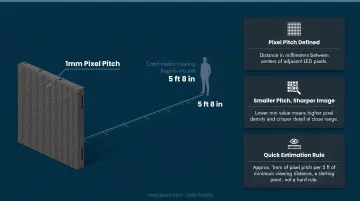
Pixel pitch is the distance in millimeters between the centers of adjacent LED pixels. Smaller pitch = higher pixel density = sharper image at closer distances.
According to Planar's viewing distance documentation, for a 1mm pixel pitch, comfortable viewing begins around 5 feet 8 inches under average conditions. A common shorthand is approximately 1mm of pixel pitch per 5 feet of minimum viewing distance — useful for quick estimation, but treat it as a starting point rather than a hard rule.
| Pixel Pitch | Comfortable Viewing Distance | Typical Application |
|---|---|---|
| 0.9–1.9mm | 5–15 feet | Control rooms, boardrooms, broadcast studios |
| 2.5–3.9mm | 12–25 feet | Church sanctuaries, auditoriums, retail |
| 4mm+ | 20+ feet | Lobbies, stadiums, outdoor signage |
Brightness (Nits)
Brightness requirements vary widely by environment. Mainstream indoor DVLED panels from brands like Absen range from roughly 600 to 1,500 nits for standard commercial applications, with specialized indoor products reaching 3,000 nits for bright venues. Outdoor DVLED panels can exceed 5,000 nits to remain visible in direct sunlight.
For comparison, LG's commercial LCD video wall panels top out around 700 nits in current product lines. DVLED's brightness ceiling is substantially higher.
Refresh Rate
Refresh rate (Hz) determines how many times per second the display updates its image. For broadcast studios and video-heavy production environments, this is critical — a low refresh rate display will strobe or flicker on camera, which is immediately disqualifying for broadcast use.
Premium DVLED panels achieve refresh rates of 3,840 Hz to 7,680 Hz, compared to 60 Hz on standard commercial LCD video walls. That gap is exactly why broadcast and live event environments almost exclusively spec DVLED.
Contrast Ratio
Samsung's The Wall All-in-One DVLED lists contrast ratios up to 24,000:1, versus 1,000:1 to 1,200:1 on comparable LG LCD video wall panels. That difference comes down to how the technology works: DVLED pixels produce true black by going completely dark when off, while LCD panels always allow some backlight bleed through.
IP Rating (Outdoor Installations)
IP ratings indicate resistance to dust and moisture. The first digit covers solid particle protection; the second covers liquid protection. Absen's outdoor AW Series carries an IP65 rating — dust-tight and protected against water jets — which is a verified benchmark for outdoor DVLED installations. Indoor displays typically require no IP rating, but any outdoor installation should have IP65 or higher confirmed before purchase — not retrofitted after.
Benefits of Direct View LED Over Other Display Technologies
Versus LCD Displays
LCD video walls have one fundamental problem: every panel has a physical bezel. At any scale, that means a visible grid of lines across the image. DVLED tiles mount edge-to-edge with no bezel at all.
Beyond the seamless image, the performance gap is significant:
- Brightness: DVLED reaches brightness levels LCD simply cannot match — relevant anywhere ambient light is a factor
- Contrast: True black versus backlight bleed; DVLED contrast ratios are often 10–20x higher
- Lifespan: Lifespan: Samsung cites 100,000 hours to half-brightness for DVLED; LG's commercial LCD panels list 60,000 hours typical
- Refresh rate: At 3,840 Hz vs. 60 Hz, there's no comparison for broadcast or motion-heavy content
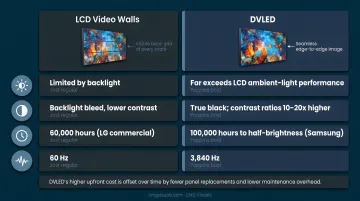
That lifespan gap has a direct cost implication: DVLED's higher upfront price is offset over time by fewer panel replacements and lower maintenance overhead.
Versus Projection
Projectors have two practical limitations that DVLED eliminates entirely:
- Ambient light sensitivity: Projection requires a dark, controlled environment. Any ambient light washes out the image. DVLED emits its own light and holds up in naturally lit lobbies, retail floors, and outdoor venues where projection simply fails
- Throw distance: A projector needs physical separation from the screen — the larger the image, the more space required, and any obstruction breaks the beam. DVLED forms the image at the surface itself, with no throw distance, no shadow risk, and no space consumed behind the display
Types of LED Pixels in Direct View Displays
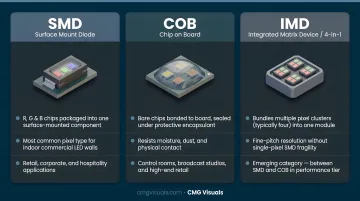
Not all DVLED panels use the same pixel construction. The three main types differ in how LEDs are packaged and protected:
- SMD (Surface Mount Diode) — Red, green, and blue chips packaged into a single surface-mounted component. The most common pixel type for indoor commercial LED walls, covering retail, corporate, and hospitality applications.
- COB (Chip on Board) — Bare LED chips bonded directly to the circuit board and sealed under a protective encapsulant. The encapsulant resists moisture, dust, and physical contact, making COB the go-to choice for fine-pitch environments where viewers are close — control rooms, broadcast studios, and high-end retail.
- IMD (Integrated Matrix Device / 4-in-1) — A newer format that bundles multiple pixel clusters (typically four) into one module. IMD sits between SMD and COB, delivering fine-pitch resolution without the fragility of single-pixel SMD at tight pitches. It's still an emerging category rather than an established standard.
Where Direct View LED Is Used
DVLED appears across commercial and professional environments where visual impact is non-negotiable and displays need to perform consistently over time. The applications vary widely, but the requirements — brightness, reliability, and scalability — stay the same.
Indoor Commercial Environments
- Corporate lobbies and conference rooms
- Broadcast and production studios
- Houses of worship
- Sports venues and arenas
- Retail showrooms and bars/restaurants
- Control rooms and hospitality spaces
- Tradeshows and event productions
Outdoor and Semi-Outdoor Applications
Common deployments include stadiums, building facades, outdoor digital signage, and event stages. Outdoor panels require appropriate IP ratings and significantly higher nit counts to remain visible in direct sunlight — they are engineered differently than indoor panels and must be specified as such from the outset.
Rental and Event Production
DVLED's modular design makes it ideal for temporary installations — concerts, corporate events, tradeshows, and broadcast sets. Panels assemble and disassemble quickly, and configurations can be customized per event. CMG Visuals maintains rental inventory specifically for this purpose, with panels deployed for events ranging from trade show booths to large outdoor gatherings.
How to Choose the Right Direct View LED Display
DVLED is not one-size-fits-all. The right display for a broadcast studio is completely different from the right display for a church sanctuary or an outdoor stadium. Starting with the wrong variables leads to overspending on resolution you can't perceive, or under-specifying brightness for a space that defeats the image.
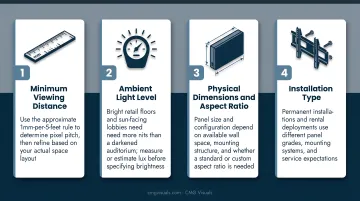
Start With These Four Variables
- Minimum viewing distance — Use the approximate 1mm-per-5-feet rule to determine pixel pitch, then refine based on your actual space layout
- Ambient light level — Bright retail floors and sun-facing lobbies need more nits than a darkened auditorium; measure or estimate lux before specifying brightness
- Physical dimensions and aspect ratio — Panel size and configuration depend on available wall space, mounting structure, and whether a standard or custom aspect ratio is needed
- Installation type — Permanent installations and rental deployments use different panel grades, mounting systems, and service expectations
CMG Visuals' Specification Approach
CMG Visuals starts with a discovery consultation and a formal site assessment before any product recommendation is made. Client-provided measurements alone regularly produce mismatched specs — so the on-site evaluation covers:
- Viewing distances and sightline angles
- Ambient lighting conditions
- Power and structural capacity
- Signal infrastructure and routing
From there, pixel pitch recommendations span from P0.9 for ultra-fine-pitch applications — like the 163-inch near-4K installation completed for WAC Lighting in Dallas — through coarser pitches for large-venue and outdoor use. As an independent integrator with direct OEM sourcing and no distributor brand obligations, CMG Visuals selects panels based on the customer's actual space, not available inventory. Every sold screen includes a 5-year hardware warranty and lifetime product support.
Frequently Asked Questions
What is the difference between LED and Direct View LED?
Standard "LED" displays — TVs, monitors, and commercial LCD panels — use LEDs only as a backlight behind a liquid crystal layer. The LCD still forms the image. In Direct View LED, the LEDs are the pixels themselves, emitting light directly to the viewer with no LCD layer involved. It's a fundamentally different architecture.
What's better, direct lit LED or QLED?
Both direct-lit LED and QLED are LCD-based technologies — QLED simply adds a quantum dot layer for better color. Direct View LED removes the LCD entirely, delivering higher brightness ceilings, true infinite contrast, and seamless scalability that neither LCD variant can match. The tradeoff is a higher upfront price.
What pixel pitch do I need for my space?
A common starting rule is approximately 1mm of pixel pitch per 5 feet of minimum viewing distance. A conference room where viewers sit 10 feet away calls for roughly a 2mm pitch or tighter; a lobby display viewed from 30 feet can use a much coarser pitch without visible quality loss. Exact recommendations require knowing your actual space dimensions and seating layout.
How long do Direct View LED displays last?
The industry benchmark is 100,000 hours to 50% brightness — that's gradual dimming, not sudden failure. Commercial LCD video walls typically rate at 60,000 hours by comparison. Front-accessible module replacement on most DVLED products extends real-world service life well beyond either figure.
Can Direct View LED displays be used outdoors?
Yes — when the product is rated for outdoor use. Outdoor DVLED panels carry appropriate IP ratings (IP65 is a verified benchmark for weather-resistant products) and higher nit counts for daytime visibility. Use only panels whose environmental ratings cover the planned exposure conditions. Indoor-rated panels are not interchangeable with outdoor-rated ones.
Is Direct View LED worth the investment compared to a projector or LCD video wall?
For permanent installations, DVLED usually wins on total cost of ownership. The higher upfront price is offset by a longer rated lifespan, no lamp replacements, and lower maintenance over time. For temporary or budget-constrained needs, rental is a practical alternative worth considering.