Introduction
Buying the wrong LED panel is an expensive mistake — and one that can't be fixed without replacing the hardware entirely.
A panel that's too dim becomes unreadable in a sunlit atrium. A pixel pitch that's too coarse turns a boardroom presentation into a visible grid of dots. An indoor-rated cabinet installed in a semi-outdoor loading bay fails within months.
These failures are predictable — and entirely avoidable. They happen when panel type is chosen based on price or availability rather than environment and application.
This guide covers the five main types of commercial LED panels: indoor fine-pitch, outdoor, rental and staging, transparent, and flexible/creative. For each type, you'll find what it's built for, where it performs best, and where it fails, so you can match the right hardware to the right space before comparing brands or getting quotes.
Key Takeaways
- LED panels come in five distinct types, each engineered for specific environments and viewing distances
- Indoor and outdoor panels are not interchangeable: brightness and weatherproofing specs differ significantly
- Pixel pitch, ambient light, and installation permanence are the three factors that determine the right type
- Rental-grade panels are optimized for repeated handling, not permanent wall integration
- Match panel type to application before comparing price — it prevents the costliest mistakes
What Are LED Panels and Why Do They Matter?
Direct-view LED panels work differently from the LED-backlit LCD screens most people are familiar with. In a direct-view LED display, each red, green, and blue diode functions as an actual image-forming pixel — the diode itself emits light directly, with no separate backlight or liquid crystal layer in between. This distinction matters practically: it's why direct-view LED panels can achieve brightness levels and contrast ratios that LCD-based displays cannot match.
That performance gap is driving real market growth. Grand View Research's December 2024 report estimates the global LED modular display market at USD $7.53 billion in 2023, with projections reaching USD $17.84 billion by 2030 — driven largely by adoption in corporate, broadcast, retail, and outdoor signage environments.
Choosing the wrong panel type affects more than image quality. It affects operational costs, maintenance frequency, and lifespan. Getting the category right is the first decision — it has to come before any discussion of brands or price.
Common mismatches include:
- Outdoor panel used indoors: runs at thousands of nits in a space that needs hundreds, consumes excess power, and generates fan noise where silence matters
- Indoor panel in a sun-exposed space: becomes unreadable under direct ambient light
- Wrong IP rating for environment: accelerates hardware degradation and voids warranty coverage
Types of LED Panels
LED panels are not a single product category. Each type is purpose-built for specific conditions, and the differences go well beyond price — they affect image quality, durability, installation method, and long-term maintenance.
Indoor Fine-Pitch LED Panels
Indoor fine-pitch panels are direct-view LED displays with pixel pitches typically ranging from P0.6mm to P2.5mm, housed in slim cabinets designed for controlled indoor environments. The "fine pitch" designation refers to the tight spacing between LEDs, which is what produces sharp, high-resolution images at close viewing distances.
These are the panels deployed in:
- Corporate boardrooms and conference rooms
- Broadcast and production studios
- Control rooms
- Houses of worship
- Retail showrooms and lobbies
The defining advantage is resolution at short range. Planar's viewing distance guidelines offer a practical rule of thumb — minimum comfortable viewing distance in feet roughly equals pixel pitch in millimeters multiplied by ten. A P1.5mm panel suits spaces where viewers are seated around 8–15 feet away; a P2.5mm panel works for distances of 14–25 feet.
CMG Visuals has deployed fine-pitch panels across these environments with meaningful variation by use case:
| Environment | Pixel Pitch | Example Project |
|---|---|---|
| Corporate boardroom | P0.9mm | WAC Lighting, Long Island, NY — 135" 4K wall |
| Broadcast studio | P1.2–P1.25mm | BCB Live, Blaze Media Election Night |
| House of worship | P1.5–P2.6mm | Grace Avenue Methodist (P1.5), Keystone Church (P2.6) |
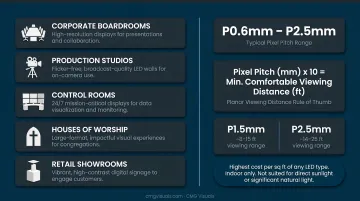
The primary trade-off: Indoor fine-pitch panels carry the highest cost per square foot of any LED panel type. They're not weatherproof, and they become visually insufficient in spaces with significant natural light or direct sun exposure.
Outdoor LED Panels
Outdoor LED panels are built around two requirements that indoor panels cannot meet: extreme brightness and environmental protection.
Brightness is the defining specification. Manufacturer product lines from Absen, Daktronics, and Planar confirm outdoor panels operating at 5,000 to 10,000 nits — necessary to remain visible against direct sunlight. CMG Visuals' outdoor configurations match this range: the P3.9 outdoor panel used for the Texas Health Resources groundbreaking event runs at 5,000 nits; the P6.67 101OF Series installed for RV Station's roadside signage in Oklahoma runs at 10,000 nits.
Environmental sealing is the second requirement. IP65 — the standard specification for outdoor LED panels — means the enclosure is dust-tight and resistant to water jets. This is a product-level characteristic, not a regulatory mandate, but it's the minimum to verify before any outdoor installation.
Best-suited applications:
- Exterior building signage
- Stadium scoreboards and perimeter displays
- Digital billboards and roadside signage
- Outdoor event screens
- Transportation hubs
Primary limitation: Most outdoor panels start at P4mm and above, putting the minimum comfortable viewing distance at 10 feet or more (premium lines extend to P2.5mm, but cost scales accordingly). Installing an outdoor panel in a confined indoor space produces visible pixelation and wastes the investment in weatherproofing and high-brightness hardware.
Rental and Staging LED Panels
Rental and staging panels are engineered for a fundamentally different operational model: repeated assembly, transport, disassembly, and reassembly across different venues. The hardware reflects this — quick-lock connections, corner-protection guards, front and rear serviceability, and compatibility with road cases and rigging hardware are design features, not accessories.
Pixel pitches in this category typically span P1.9mm to P4.8mm, balancing resolution against the reality that rental panels serve varied venues and viewing distances.
CMG Visuals' 101R and 201R Series rental inventory is available in P1.5, P1.9, and P2.6 configurations. The P2.6 variant has been confirmed across multiple event deployments, including the Dallas Mavericks NBA Draft at Victory Park and trade show installations at the Gaylord Texan Resort.
Best-suited use cases:
- Trade shows and conference booths
- Corporate events and product launches
- Concerts and touring productions
- Outdoor groundbreaking ceremonies and branded activations
Key trade-off: Rental panels accumulate connector wear through handling cycles. At equivalent price points, image quality is generally below dedicated fine-pitch indoor panels. They're not designed to be integrated permanently into wall mounts — doing so wastes the mobility engineering built into the cabinet and typically results in a suboptimal permanent installation.
Transparent LED Panels
Transparent LED panels use an open-grid structure (LEDs mounted on narrow bars with large open areas between them) that lets viewers see through the display while content plays. Verified products from LG and Unilumin demonstrate transparency rates in the 52–60% range — LG's 14mm transparent film is rated at 1,000 nits; Unilumin's XV Series reaches 2,000–4,000 nits.
Best-suited environments:
- Retail storefront windows
- Showroom glass partitions
- Architectural glass facades
- Airport and transportation terminals
- Stage and entertainment venues where background visibility is part of the design
Content design matters more with transparent panels than any other type. Dark or black areas in the content effectively disappear — they read as transparent — while lit elements appear to float in space. Content needs to be built around this behavior from the start, not adapted to it after the fact.
Primary limitations: Overall brightness is lower than equivalent solid-panel configurations at most price points, and installation requires careful structural anchoring to glass or architectural framing.
Flexible and Creative LED Panels
Flexible and creative LED panels use hinged cabinet systems, soft-backed modules, or interlocking curved tiles to build displays that standard flat panels cannot. Form factors include cylinders, concave and convex curves, 90-degree arcs, spheres, and irregular surface configurations.
Best-suited environments:
- Branded architectural installations
- Experiential marketing activations
- Curved stage backdrops
- Entertainment venues seeking signature display elements
- Any project where a flat rectangular screen doesn't serve the visual concept
CMG Visuals offers specialty configurations including curved, cylinder, and 90-degree formats within its product lineup — applied where standard flat panels would break the design intent of the space.
Trade-offs: Significantly higher cost than flat-panel equivalents, more complex installation requiring specialist engineering assessment, and geometry-specific limitations on which cabinet sizes work for a given radius or surface profile.
How to Choose the Right LED Panel Type
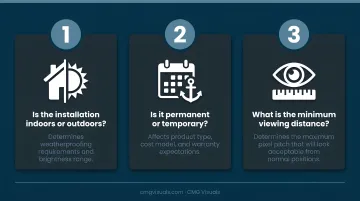
The right panel type becomes clear when you answer three questions before looking at any product:
- Is the installation indoors or outdoors? This determines weatherproofing requirements and brightness range.
- Is it permanent or temporary? This affects product type, cost model, and warranty expectations.
- What is the minimum viewing distance? This determines the maximum pixel pitch that will look acceptable from normal positions.
Pixel Pitch Selection
For indoor panels, use Planar's verified formula as a starting point: minimum comfortable viewing distance in feet ≈ pixel pitch in mm × 10. Applied practically:
| Pixel Pitch | Comfortable Viewing Distance |
|---|---|
| P0.9mm | ~9 ft minimum |
| P1.5mm | ~15 ft minimum |
| P2.0mm | ~20 ft minimum |
| P2.5mm | ~25 ft minimum |
Choosing a finer pitch than the space requires adds cost without adding perceived quality. Choosing a coarser pitch than the distance demands produces visible pixelation that no calibration can fix.
Pixel pitch sets your resolution floor — brightness determines whether the image holds up in your specific environment.
Brightness by Environment
Product benchmarks from major manufacturers establish these practical ranges:
- Controlled indoor spaces: 800–1,500 nits (CMG Visuals' indoor FAQ confirms 800–1,000+ nits as the typical indoor operating range)
- High-ambient or window-facing spaces: 2,500–3,500 nits
- Direct-sun outdoor installations: 5,000–10,000 nits
Permanence and Total Cost of Ownership
A permanent installation justifies higher upfront investment in fine-pitch panels backed by a comprehensive warranty. CMG Visuals' fixed installations include a 5-year hardware warranty, 10-year remote support, and lifetime product support — factors that substantially change the five-year cost comparison against a cheaper panel with limited coverage.
For recurring events, the calculus shifts:
- A P2.6 rental setup for quarterly events rarely justifies permanent installation costs
- Rental deployments with setup and teardown included often deliver better economics
- Capital stays available for other priorities rather than tied up in depreciating hardware
CMG Visuals' NovaStar-certified engineers conduct site assessments and develop specifications based on the actual environment, viewing requirements, and budget — with no obligation to push specific brands or inventory.
Common LED Panel Buying Mistakes to Avoid
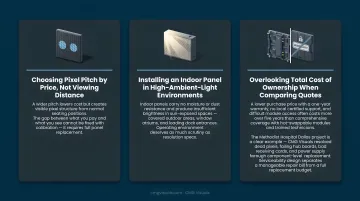
Choosing pixel pitch by price, not viewing distance. A wider pitch reduces cost but produces visible pixel structure from normal seating positions. That gap between what you pay and what you see isn't correctable with calibration — it requires replacing the panels entirely.
Installing an indoor panel in a high-ambient-light environment. Indoor panels carry no moisture or dust resistance and produce insufficient brightness in sun-exposed spaces — covered outdoor areas, floor-to-ceiling window atriums, loading dock entrances. Operating environment deserves as much scrutiny as resolution specs before you buy.
Overlooking total cost of ownership when comparing quotes. A lower purchase price paired with a one-year warranty, no local certified support, and difficult module access often costs more over five years than a panel with comprehensive coverage, hot-swappable modules, and trained technicians nearby.
The Methodist Hospital Dallas project is a clear example. CMG Visuals resolved dead pixels, failing hub boards, bad receiving cards, and power supply failures through component-level replacement — no full panel swap required. Serviceability design is what made that outcome possible, and it's what separates a manageable repair bill from a full replacement budget.
Frequently Asked Questions
How many types of LED panels are there?
Commercial and professional LED panels fall into five primary types: indoor fine-pitch, outdoor, rental and staging, transparent, and flexible/creative. Each is engineered for different environments and applications.
What is LED, QLED, and OLED?
Direct-view LED panels use light-emitting diodes as the actual image-forming pixels. QLED is an LCD television with a quantum dot filter that improves color but still uses LED backlighting — the pixels are liquid crystal, not LED. OLED uses organic compounds where each pixel emits its own light. Large commercial video walls use direct-view LED, not QLED or OLED.
What are the different types of TV panels?
Consumer TV formats include LED-backlit LCD, OLED, QLED, and Mini-LED. Commercial LED video walls use direct-view LED technology — a fundamentally different product category with modular construction, far greater scalability, and brightness levels no consumer TV panel reaches.
What is the difference between indoor and outdoor LED panels?
Two things: brightness and weatherproofing. Outdoor panels produce 5,000–10,000 nits to remain readable in direct sunlight; indoor panels operate at 800–1,500 nits. Outdoor panels carry IP65 ratings sealing them against dust and water jets; indoor panels have no weather resistance and are not designed for moisture-exposed environments.
What pixel pitch should I choose for my LED display?
Match pixel pitch to your minimum viewing distance — finer pitch for close-range indoor viewing, larger pitch for long-distance outdoor or event use. Planar's guideline of pitch (mm) × 10 = comfortable viewing distance (feet) is a useful starting point. Confirm the specification with a certified LED specialist before purchasing.
How long do LED panels last?
Commercial-grade LED panels are rated for 100,000 hours — defined as the point at which brightness drops to 50% of rated output, not total failure. Achieving that lifespan depends on proper installation, calibrated operating brightness, and routine certified maintenance.