For organizations running corporate boardrooms, event venues, houses of worship, or retail spaces, understanding how LED color affects mood and well-being isn't just interesting. It's operationally relevant. The wrong color choices can undermine the purpose of a space entirely.
This article breaks down the science behind LED color psychology, explains what each color actually does, and shows how to apply that knowledge in real commercial environments.
Key Takeaways
- Warm colors (red, orange, amber) stimulate and energize; cool colors (blue, green, purple) calm and focus — intensity and timing determine the actual effect on sleep and alertness
- Blue light suppresses melatonin significantly more than red — avoid dominant blue in evening environments
- Color temperature (measured in Kelvin) controls the psychological character of white light: warmer Kelvin values relax, cooler values alert
- Color choices in LED display content directly shape audience mood — commercial spaces can align on-screen visuals to the emotional tone of any event or presentation
The Science: How LED Colors Affect Your Brain and Body
The effect of light on mood isn't subjective. It runs through a documented biological pathway.
The Biology Behind It
Your retina contains specialized photoreceptor cells called intrinsically photosensitive retinal ganglion cells (ipRGCs). These cells contain a photopigment called melanopsin and connect directly to the hypothalamic suprachiasmatic nucleus (the brain's master circadian clock).
Light signals routed through this pathway regulate alertness, hormone production, sleep-wake cycles, and mood.
This means light color doesn't just feel different. It triggers different hormonal responses depending on wavelength, intensity, and timing.
The most clinically significant finding: blue-spectrum light suppresses melatonin far more aggressively than red-spectrum light. The data makes the gap hard to ignore:
| Light Condition | Melatonin After 2 Hours | Circadian Shift |
|---|---|---|
| 464-nm blue LED (80 lux) | 7.5 pg/mL | ~3 hours |
| 631-nm red LED (80 lux) | 26.0 pg/mL | — |
| Green light (equivalent brightness) | — | ~1.5 hours |
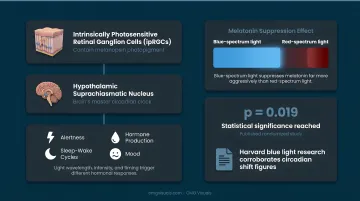
The melatonin difference reached statistical significance (p=0.019) in a published randomized study. Harvard's blue light research corroborates the circadian shift figures.
Psychology on Top of Physiology
Color effects aren't purely biological. Emotional responses layer on top of the hard physiology. Cultural associations, personal memory, and context all shape how we interpret a given color.
A red-lit room feels charged and exciting in a nightclub. The same color in a hospital room feels alarming. Purple reads as spiritual in a sanctuary and as edgy in a bar. Context modifies the emotional meaning of any given color, which is why good lighting design requires understanding both the biology and the environment.
Why LED Color Differs from Paint Color
That context distinction also applies at the technical level. LED displays work on an additive color model: red, green, and blue light combine to produce the full visible spectrum, with equal intensities of all three producing white. Pigment works subtractively — paint absorbs certain wavelengths and reflects others.
This matters because findings about paint color or interior design color psychology don't automatically translate to emitted LED light. The mechanisms are different, and treating them as equivalent leads to flawed conclusions.
LED Color Effects: What Each Color Does to Your Mood
Red LED Light
Red light increases physiological arousal. In a controlled within-subject study of 14 adults, 60-minute exposure to 630-nm red LEDs at 40 lux significantly increased heart rate and shifted EEG patterns toward alertness versus lower-intensity red. A separate 2025 exercise study found acute red-light exposure increased aerobic capacity and reduced perceived effort in participants.
Best-fit environments:
- Entertainment venues and performance spaces (short-burst accent lighting)
- Gyms and fitness areas (not all-day saturation)
- Stage design where high energy is the goal
Caution: Prolonged saturated red environments can tip from energizing to anxiety-inducing. Works best as an accent, not the dominant color.
Orange and Amber LED Light
At moderate intensities, long-wavelength amber light suppresses melatonin significantly less than short-wavelength blue. That makes it the safer choice for evening environments where relaxation matters. It also carries strong associations with warmth and social comfort — qualities that land well in hospitality settings.
Best-fit environments:
- Restaurants and dining spaces
- Hospitality lobbies and reception areas
- Evening-use event spaces where post-event sleep quality matters
Yellow LED Light
Yellow promotes a sense of brightness and warmth without the physiological intensity of red. In LED experiments with students, yellow produced the highest bright and warm impressions and registered differently from blue on measured excitement scores. It's stimulating in a light, social way — better suited to communal energy than deep focus.
Best-fit environments:
- Collaborative workspaces and coworking areas
- Retail environments near promotional displays
- Public gathering spaces where approachability matters
Blue LED Light
Blue light promotes alertness, attention, and cognitive performance during the day — a direct asset in offices and focus-heavy environments. At night, that same activating quality becomes a liability: it disrupts melatonin production and pushes circadian timing later.
Best-fit environments:
- Offices and control rooms during daytime hours
- Broadcast studios and production environments
- Fitness facilities with daytime-heavy use
Hard limit: Avoid dominant blue in evening event spaces. Guests' comfort and sleep quality after the event are affected by what they're exposed to during it.
Green LED Light
Green occupies the center of the visible spectrum, where the human eye's photopic sensitivity peaks near 555 nm — meaning it's processed with less strain than any other color. Clinical evidence also shows narrowband green light exacerbates migraine photophobia significantly less than white, blue, amber, or red. Claims about green reducing mental fatigue in general populations are less conclusively proven, but its low visual demand makes it a practical choice for extended-exposure environments.
Best-fit environments:
- Wellness centers and healthcare-adjacent spaces
- Meditative or spiritual environments
- Study areas where sustained, low-fatigue attention is the goal
Purple LED Light
Purple combines red's energy with blue's calm, producing a color that tends toward creativity, spirituality, and a sense of elevated occasion. A 2025 neurophysiological study testing 18 LED conditions found low-illuminance purple lighting produced more positive emotional measures and favorable frontal alpha asymmetry than several alternatives. That said, audience response varies more than with red or blue — test purple at low illuminance before committing to it as a dominant tone.
Best-fit environments:
- Worship spaces and meditation environments
- Creative studios
- Upscale hospitality and event design where exclusivity or transcendence is the goal
White LED Light and Color Temperature
Colored LEDs get most of the attention, but white LED light — and specifically its color temperature — carries its own significant psychological weight.
The Kelvin Scale in Practice
| Color Temperature | Character | Best Use |
|---|---|---|
| 2700K–3000K (warm white) | Candlelight/sunset quality | Restaurants, hospitality, evening spaces |
| 4000K–5000K (neutral white) | Natural daylight quality | Offices, meeting rooms, retail |
| 5000K–6500K (cool white) | Midday sun quality | Focus-intensive work, broadcast studios |
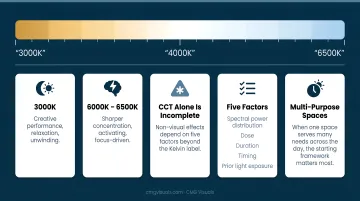
Research supports this framework: a 2021 simulated workspace study found 6500K more activating and 3000K more relaxing, though results interacted with the surrounding room color. A separate study found 3000K supported creative performance, while 6000K drove sharper concentration.
Kelvin alone doesn't tell the full biological story. The CIE and IES both note that non-visual effects depend on five factors beyond CCT label: spectral power distribution, dose, duration, timing, and prior light exposure. Treat Kelvin as a starting framework, then validate against actual conditions.
That starting framework matters most when a single space needs to serve multiple purposes throughout the day.
Why Tunable White Matters for Multi-Use Spaces
A corporate boardroom that hosts focused morning strategy sessions and relaxed afternoon onboarding needs different color temperatures at different times. Tunable white LED technology — which mixes warm and cool channels to shift CCT on demand — is the practical solution for any space with changing purposes throughout the day.
Applying LED Color Psychology in Commercial Spaces
The stakes are higher in commercial environments than in homes. An event venue, house of worship, retail store, or corporate office shapes the experience of many people simultaneously. The wrong color decisions don't just look off — they actively work against what the space is trying to accomplish.
Environment-Specific Guidance
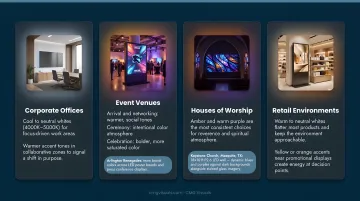
Corporate offices: Cool to neutral whites (4000K–5000K) for focus-driven work areas, with warmer accent colors in collaborative zones to signal a shift in purpose.
Event venues: Program dynamic color shifts to match the event arc. Arrival and networking benefit from warmer, social tones; ceremony calls for intentional color atmosphere; celebration phases can carry bolder, more saturated color.
For the Arlington Renegades, CMG Visuals delivered game-day content using the team's exact brand colors across LED poster boards and press conference displays — translating brand identity into atmosphere in real time.
Houses of worship: Amber and warm purple are the most consistent choices for reverence and spiritual atmosphere. At Keystone Church in Mesquite, Texas, CMG Visuals installed an 18×10 ft P2.6 LED video wall rendering dynamic blues and purples against dark backgrounds alongside stained glass imagery — creating depth and spiritual immersion that serves the congregation every service.
Retail environments: Warm to neutral whites flatter most products and keep the environment approachable. Yellow or orange accents near promotional displays create energy at decision points.
The Advantage of Programmable LED Systems
The ability to shift color dynamically is what separates intentional lighting from static, fixed choices. LED video wall systems allow organizations to program color sequences that match the emotional arc of any event, service, or presentation — rather than locking a space into a single mood for every occasion.
That flexibility also carries a practical obligation: color environments in public and professional spaces directly affect focus, fatigue, and stress. Programmable LED systems make it possible to get this right — not just once, but for every event, every service, every use case the space demands.
Frequently Asked Questions
How do LED lights affect your body?
LED lights influence the body through two overlapping pathways: physiological changes in hormone levels (melatonin, cortisol, serotonin) driven by color wavelength and intensity, and psychological responses shaped by color associations. The overall effect depends on color, intensity, timing, and duration of exposure.
What LED color is best for productivity and focus?
Cool white to blue-spectrum LED light (4000K–6000K) is most effective for focus-driven work, as these wavelengths suppress melatonin and promote alertness during daytime hours. Green is a useful secondary option for sustained concentration where you want calm attention rather than peak activation.
What is the most relaxing LED light color?
Amber and warm white light (2700K–3000K) are the most reliably relaxing options, aligning with sunset wavelengths that support melatonin production and signal the body to wind down. Soft green or low-intensity blue can also work when kept at reduced brightness.
Can LED lights cause ocular migraines?
High-intensity cool white or blue LED light — particularly with flickering or high contrast — can trigger migraines in people with photosensitivity. Warm, lower-intensity, flicker-free LED sources reduce this risk. IEEE 1789-2015 addresses flicker risk separately from color; both should be specified when sourcing displays for sensitive environments.
Are LED lights safe for people with lupus?
The Lupus Foundation reports that 40%–70% of people with lupus experience flares from UV exposure and recommends standard LEDs, which do not emit UV. For commercial display applications, confirm no UV-emitting components are present, prefer warmer-spectrum lower-intensity sources, and consult a healthcare provider for individual guidance.