These aren't isolated flukes. They share root causes: inadequate rigging, skipped structural assessments, and hardware that wasn't rated for the actual load.
LED walls are heavy, complex systems. A display that looks like a flat screen is actually a stack of panels, frames, power supplies, and mounting hardware — often weighing hundreds to thousands of pounds combined. When that system fails, the consequences range from costly to fatal.
This guide breaks down exactly why LED wall collapses happen, what warning signs to watch for, and how to prevent them.
Key Takeaways
- LED wall assemblies can weigh thousands of pounds — a partial section falling is enough to cause serious injury
- Most collapses trace to rigging errors, poor structural assessment, or substandard hardware
- Warning signs almost always appear before a full collapse; trained crews can act before failure occurs
- Safety starts at the design phase — by the time installation begins, critical structural decisions are already made
- Long-term safety depends on scheduled inspections, documentation, and personnel who know what they're looking for
Common Causes of LED Wall Collapse
An LED wall collapse means the structural system holding the display in place — rigging, mounting hardware, framing, or the wall surface itself — fails, causing panels or the entire assembly to fall. This applies to both temporary event setups and permanent installations, though each carries different risk profiles.
Collapses almost never result from random equipment failure. They trace back to identifiable, preventable root causes.
Improper Rigging and Mounting
Rigging errors are among the most dangerous failure points. Common mistakes include:
- Applying uneven load distribution across chain hoists
- Using wire rope hardware not rated for the wall's actual weight
- Securing panels to structurally insufficient anchor points
- Rushing setups without verifying load ratings against the actual assembly weight
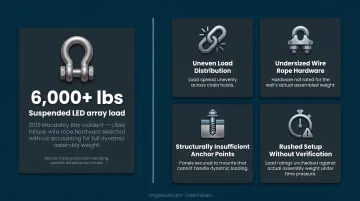
The 2019 Mandalay Bay incident is often cited here: a suspended LED array reportedly over 6,000 pounds, attributed by one trade publication to failed wire rope hardware. Even setting aside whether every detail is confirmed, the failure mode is familiar — hardware selected without accounting for the full dynamic load of the assembled wall.
That risk compounds under time pressure. Event setups with tight build windows are high-risk environments, especially when rigging crews lack experience with LED-specific loading requirements.
Structural Surface Incompatibility
Not every wall, truss, or ceiling can handle an LED array. When a display is mounted to a surface that cannot support its distributed weight (particularly in designs that minimize visible anchor points for aesthetic reasons) structural integrity drops significantly.
The ESPN Colombia broadcast collapse is often cited in this context: a "floating" video wall aesthetic reduced the number of secure mounting contact points, contributing to instability. The result was a wall segment falling onto a presenter during a live broadcast.
Overloaded or Substandard Hardware
Hardware fails when it's not rated for the combined static and dynamic load of the LED array. Dynamic loads include:
- Vibration from nearby audio systems
- Crowd movement and floor flex
- HVAC-generated oscillation
- Transport stress on touring setups
This problem compounds when components from different manufacturers are mixed without verifying compatibility. ASME B30.26 covers rigging hardware standards (shackles, wire-rope clips, turnbuckles, and hoist rings), but those ratings only protect you when the entire assembly is evaluated together — not component by component.
Poor or No Pre-Installation Structural Assessment
Skipping a formal structural assessment means building a support system on unknown tolerances. A production team arrives at a venue, mounts a large screen, and assumes the existing wall or truss can handle it. If the surface is unbraced framing, aging concrete without verified compressive strength, or drywall — it may not.
For reference, Peerless-AV's dvLED mounting system specifications require solid concrete at least 8 inches thick with a minimum compressive strength of 2,000 psi, and explicitly prohibit placing expansion anchors through drywall or plaster finishes. That's a single manufacturer's product-specific requirement, which illustrates why assumptions about "adequate" surfaces are dangerous.
What Happens When LED Wall Safety Is Ignored
The consequences of neglecting LED wall safety aren't hypothetical:
- Physical injury or death — a wall section falling onto a person in the wrong position at the wrong moment
- Liability exposure — multi-million-dollar claims against production companies, venues, and integrators
- Equipment loss — a collapsed LED array is rarely salvageable
- Reputational damage — for production companies, venues, and any brand associated with the event
- Regulatory action — OSHA and local authorities can issue citations and halt operations
Because LED arrays often weigh hundreds to thousands of pounds, even a partial section falling — as occurred during the ESPN Colombia broadcast, where only part of the wall came down — can cause serious harm. A full collapse in a crowded venue would likely be fatal.
Warning Signs Before a Collapse
Most collapses don't happen without warning. Trained crews who know what to look for can catch failure before it occurs.
Visible structural indicators:
- Panels shifting out of alignment or visible gaps between tiles
- Bowing or lean developing in the wall structure
- Fasteners that appear loose, missing, or corroded
- Visible separation between the mounting frame and the support surface
Auditory and physical indicators:
- Creaking, popping, or cracking sounds from the mounting structure
- Unexpected vibration or sway in the display during operation
- Rigging cables that appear slack on one side or show visible fraying
Operational red flags:
- Wall sections suddenly going dark or displaying distorted images — this can indicate connector cables are being stressed by frame movement, not just an electrical fault
If image anomalies coincide with any physical irregularities in the structure, treat it as a structural warning, not a routine electrical issue.
When any of these signs appear, stop operations and inspect. Waiting to see if the problem resolves itself is how partial failures become full collapses.
How to Prevent an LED Wall Collapse
Prevention is an engineering discipline, not a pre-show checklist. These practices must be applied from the design phase through ongoing operation.
Conduct a Professional Structural Assessment Before Installation
Before any hardware is ordered or installation begins, engage a qualified structural or mechanical engineer — or a certified LED integrator with formal load calculation capability — to evaluate four things:
- Verify the mounting surface — substrate type, thickness, and condition against manufacturer requirements
- Calculate total load — account for all panels, frames, power supplies, cabling, hoists, and ancillary hardware
- Confirm safety factor compliance — design factors vary by component and load type; under ANSI E1.6-1, wire rope design factors differ between static and characteristic loads depending on whether the system uses powered hoists, dead-hung rigging, or temporary ground-supported structures
- Identify required modifications — structural changes to the venue should happen at this stage, before panels arrive on-site
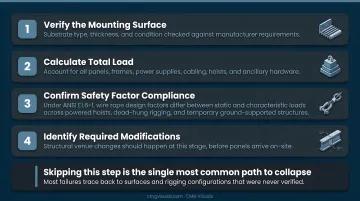
Skipping this step is the single most common path to collapse — because most failures trace back to surfaces and rigging configurations that were never verified in the first place.
Use Certified Riggers and Qualified Installers
For any flown or suspended LED wall, hire ETCP (Entertainment Technician Certification Program) certified riggers to perform all rigging work. ETCP credentials — Arena Rigger and Theatre Rigger — are built for the venues where large LED walls are most commonly deployed: arenas, convention centers, hotels, trade shows, and outdoor stages.
Certified riggers understand load behavior, equipment compatibility, and how to recognize when a setup exceeds safe parameters. The 2019 Las Vegas collapse is a direct example of what happens when that expertise is absent.
For the display hardware side, working with integrators who hold manufacturer-level certifications — such as NovaStar-certified engineers — ensures the display system and mounting configuration are set up correctly from the start. CMG Visuals' NovaStar-certified team has deployed LED systems across live events, broadcast studios, trade shows, and large-scale corporate installations where configuration accuracy directly affects safety.
Use Hardware Rated for the Actual Load
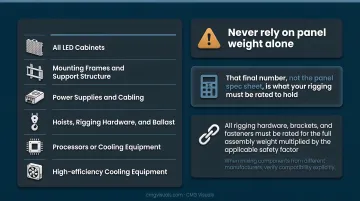
Never rely on panel weight alone. The structural calculation must include:
- All LED cabinets
- Mounting frames and support structure
- Power supplies and cabling
- Hoists, rigging hardware, and ballast
- Any processors or cooling equipment integrated into the wall
To put those numbers in context:
| Component | Typical Weight |
|---|---|
| Single 500×500mm rental panel (ROE Visual, Absen) | 12–18 lbs |
| 50-panel wall (panels only) | 600–900 lbs |
| Full assembly with frames, power, hardware | Significantly higher |
That final number — not the panel spec sheet — is what your rigging must be rated to hold.
All rigging hardware, brackets, and fasteners must be rated for the full assembly weight multiplied by the applicable safety factor. When mixing components from different manufacturers, verify compatibility explicitly — don't assume it.
Establish a Pre-Event and Pre-Activation Safety Checklist
Between installation and first use, things shift. Transport vibration, last-minute adjustments, and assembly errors can compromise a setup silently. Before powering on or admitting an audience:
- Physically inspect all rigging points, fasteners, mounting brackets, and structural connections
- Check for any visible shifting, gaps, or loosening that wasn't present after initial installation
- Document the inspection with photos and a written sign-off from a qualified crew member
- Confirm that no modifications were made to the setup after the last verified inspection
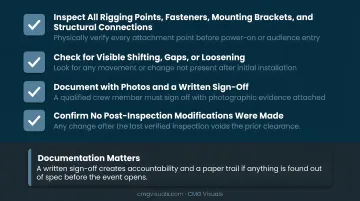
Documentation matters here. A written sign-off creates accountability — and gives you a paper trail if something is found out of spec before the event opens.
Tips for Long-Term Safety and Prevention
Safety doesn't end at installation. These ongoing practices are what separate well-managed installations from those waiting to fail.
Schedule professional inspections at defined intervals. ANSI E1.47 requires annual inspection for entertainment rigging, plus re-inspection after any alteration or unusual loading. OSHA mandates rigging checks before each shift for temporary setups. Treat both as minimums.
Maintain written documentation for every installation. Log load calculations, hardware specs, installation photos, inspection records, and every modification — no matter how minor. Undocumented changes are where new risk enters the system.
Train venue staff and crew on warning signs. Anyone working near a permanent LED wall should recognize signs of structural instability. Set a clear protocol for halting operations when a concern is raised — no schedule pressure overrides a legitimate safety call.
For touring or temporary setups, inspect at every new venue. A safe setup at the last venue isn't automatically safe at the next one. Mounting surfaces, floor load ratings, humidity, and vibration conditions all vary by location — each new environment introduces its own variables.
After any unusual event, inspect before resuming operation. Seismic activity, severe weather, abnormal crowd loads, or any system modification all warrant a physical inspection before the display goes back online. Visible damage isn't the only indicator of structural compromise.
Conclusion
LED wall collapses have identifiable causes and equally identifiable prevention measures. Improper rigging, skipped structural assessments, substandard hardware, and deferred maintenance each have a corresponding fix that any production team or venue operator can implement.
The cost of certified installation, quality hardware, documented inspections, and trained personnel is a fraction of what a structural failure actually costs. Equipment damage is the least of it. Collapses generate liability claims, shut down venues, end professional relationships, and in the worst cases, cause serious injury or death.
Safety doesn't end at installation. Inspections, load rechecks, and hardware reviews need to be built into every production cycle — not revisited only after something goes wrong. If your team hasn't formalized that process yet, that's where to start.
Frequently Asked Questions
What does a collapsed LED wall mean?
A collapsed LED wall refers to the structural failure of the mounting, rigging, or framing system holding the LED panels in place, causing part or all of the screen to fall. This ranges from a single panel detaching to an entire multi-thousand-pound assembly reaching the ground.
How much does an LED video wall weigh?
Weight varies significantly by configuration. Individual rental-grade cabinets (500×500mm) typically weigh between 12 and 18 pounds per panel, but that's cabinet weight only. Total installed weight must account for frames, power supplies, mounting hardware, cabling, and hoists — which can multiply the panel-only figure substantially.
Can an LED wall be mounted on any wall or ceiling?
No. Not all surfaces can structurally support LED wall loads. As a product-specific example, some dvLED mounting systems require solid concrete at least 8 inches thick with a minimum compressive strength of 2,000 psi. Drywall, lightweight framing, and concrete of unknown condition may be entirely unsuitable without reinforcement. A structural assessment is required before mounting to any surface.
How do I know if my LED wall is properly installed?
Proper installation requires documented load calculations, hardware rated to the correct safety factor, certified professional installation, and a completed pre-activation inspection. No visual or auditory warning signs after activation is reassuring, but it's not a substitute for documentation.
How often should an LED wall be inspected for safety?
For entertainment rigging systems, ANSI E1.47 recommends annual inspection as a baseline, with additional inspections after any alteration or repair. For temporary or touring setups, rigging hardware should be inspected before each shift per OSHA requirements. Any time a wall is moved, modified, or exposed to unusual stress, inspect it before the next use.
What's the safety difference between a temporary and permanent LED wall installation?
Temporary installations introduce compounding risk through repeated assembly and disassembly, varying venue surfaces, and time pressure — each new venue is a new structural unknown. Permanent installations face hardware fatigue, corrosion, and environmental degradation that builds gradually and goes unnoticed without scheduled inspections.