Both technologies have earned their place on professional sets. Green screen compositing has powered decades of blockbusters and broadcast television. LED virtual production, meanwhile, has gone from a novelty to a genuine industry standard in a matter of years — according to Omdia, the virtual production market generated $138.7 million in revenue in 2023 and is forecast to exceed $1.1 billion by 2028.
Neither option is universally superior. The right answer depends on your budget structure, timeline, content type, and how you want to distribute creative effort across pre-production, shoot day, and post.
Key Takeaways
- Green screens cost less upfront and maximize post-production flexibility.
- LED volumes deliver realistic in-camera lighting and reflections that green screen can't replicate on set.
- LED volumes shift creative decisions from post into pre-production — actors see their environment, directors evaluate composition in real time.
- Pixel pitch below 2.5mm is generally recommended for close-range camera work on LED volume stages.
- Hybrid workflows using LED for hero shots and green screen for wide extensions often offer the best cost-to-quality ratio.
- The right choice comes down to budget structure, delivery timeline, and how much in-camera realism your production requires.
What Is a Green Screen?
A green screen (chroma key) uses a uniformly lit colored backdrop — almost always bright green or blue — that compositing software replaces with any background in post-production.
Green became the standard color because most digital camera sensors use a Bayer pattern that captures green pixels at twice the rate of red or blue. It also contrasts sharply with human skin tones, reducing edge artifacts.
How It Works in Practice
Adobe recommends lighting the backdrop at 40–50% luminance with diffused, nondirectional sources and a flat waveform response, keeping at least 10–15 feet between the subject and the screen to minimize color spill. Shooting in 4:2:2 chroma subsampling rather than 4:2:0 also preserves more color information for a cleaner key.
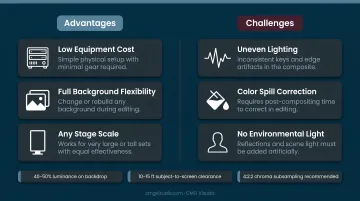
Core advantages:
- Low equipment cost and simple physical setup
- Full flexibility to change or rebuild backgrounds during editing
- Works at any stage scale, including very large or tall sets
Those advantages come with real tradeoffs on set, though.
Key challenges:
- Uneven lighting creates inconsistent keys and edge artifacts
- Color spill requires correction in post, adding compositing time
- Props and talent don't receive environmental light or reflections — those must be added artificially
When Green Screen Makes Sense
Green screen remains the right call in specific scenarios:
- Heavy CGI environments built entirely in post
- Multi-version campaigns where the same footage needs different background edits
- Very large-scale sets (four-story ceilings, wide action scenes) where building an LED volume would be cost-prohibitive
- Projects where creative direction may evolve significantly after the shoot day
What Is Virtual Production with an LED Volume?
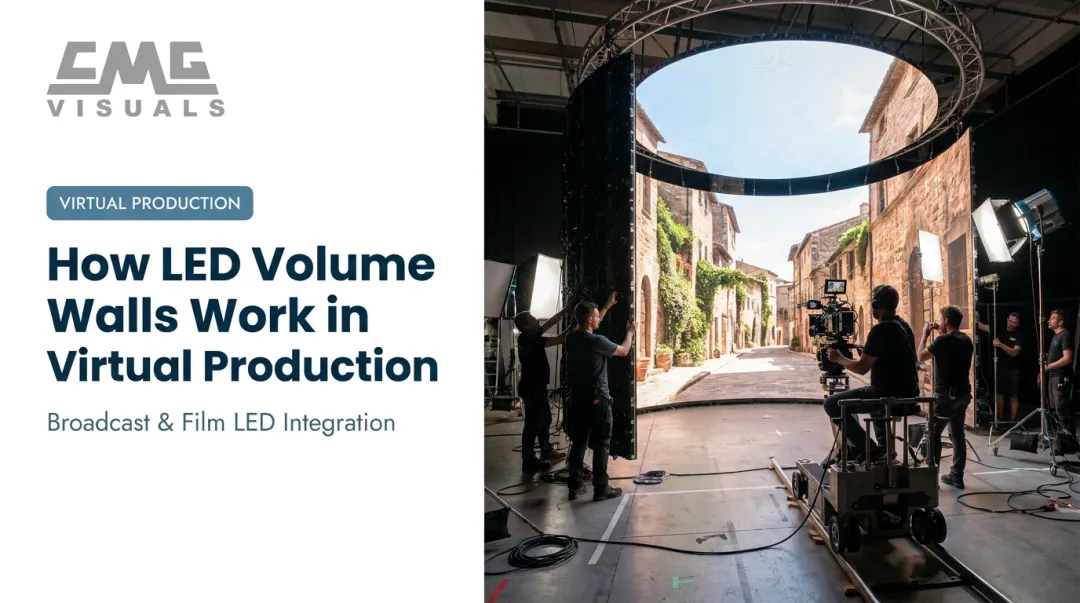
An LED volume is a large, curved array of high-resolution LED panels surrounding actors and set pieces, displaying photorealistic 3D environments rendered in real time — typically through Unreal Engine using a system called nDisplay.
A camera tracking system relays the physical camera's position to the render engine, which updates the virtual scene's perspective continuously. This creates genuine parallax: near and far objects shift by different amounts as the camera moves, exactly as they would on a real location.
The Light Source Distinction
The biggest practical difference between the two technologies is physical, not visual. LED panels emit colored light. That light wraps naturally around talent, props, and set pieces, producing reflections and color interactions that are impossible to fake with a green screen backdrop. For Poor Things, the production chose an LED volume over chroma key specifically because the set contained extensive glass and reflective surfaces — materials that would have required extremely complex spill cleanup in post.
The Workflow Shift
With green screen, most creative decisions happen in post. With an LED volume, they happen before the shoot. Real-time 3D artists build digital environments during pre-production, and on shoot day, directors and actors see the complete scene. This has two downstream effects:
- Actor performance improves — performers react to an environment they can actually see rather than imagining it against a blank canvas
- On-set decisions are faster — directors can evaluate composition, lighting interaction, and environment tone in real time, reducing guesswork and reshoot risk
Technical Considerations
LED volume stages require investment beyond the panels themselves:
- High-resolution panels with fine pixel pitch (typically 2.5mm or smaller for close-range camera work)
- Real-time render nodes and processing hardware
- Camera tracking systems (optical, infrared, or inertial)
- Calibration between the physical lens and the virtual camera
- Specialized technical crew who understand both the LED hardware and the render pipeline
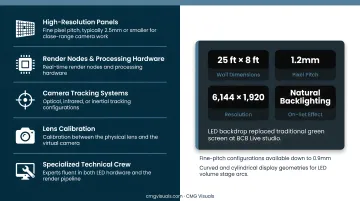
CMG Visuals' BCB Live studio installation is a practical example of these specs in action: a 25-foot by 8-foot wall at 1.2mm pixel pitch and 6,144 × 1,920 resolution, where the LED backdrop replaced a traditional green screen and delivered natural backlighting effects on set.
CMG also offers fine-pitch configurations down to 0.9mm and curved or cylindrical display geometries suited to the typical arc of an LED volume stage.
When LED Virtual Production Makes Sense
- Automotive commercials and branded content where reflective surfaces matter (Volkswagen captured ice cave, forest, desert, and cyberpunk city locations for its ID.4 launch in two days on an LED volume stage)
- Television series with recurring interior environments that need consistent lighting across episodes
- Narrative drama and brand campaigns where actor performance depends on environmental immersion
- Productions with tight delivery schedules that can't absorb weeks of compositing
Green Screen vs. Virtual Production: Quick Comparison
| Factor | Green Screen | LED Volume |
|---|---|---|
| Upfront Cost | Lower: backdrop, rigging, and controlled lighting | Higher: panels, processing, tracking, and specialized crew |
| Setup Complexity | Physically simple; requires precise, even lighting | Technically complex; requires a pre-production 3D environment build |
| Lighting for Talent | Separate and independent from the backdrop | Panels act as a dynamic, environment-colored light source |
| Post-Production Workload | Heavy: keying, spill correction, edge cleanup, full composite | Minimal: near-final-pixel results captured in camera |
| Actor/Director Experience | Actors perform against an empty backdrop with no visual reference | Actors see the full environment; directors evaluate composition live |
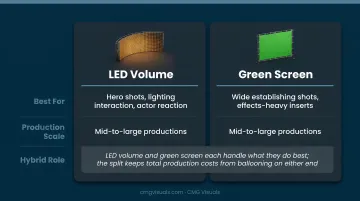
A hybrid approach — LED volume for hero shots where lighting interaction and actor reaction are critical, green screen for wide establishing shots or effects-heavy inserts — is common on mid-to-large productions. Each method handles what it does best, and the split keeps total production costs from ballooning on either end.
Which Is Better for Your Production?
There's no universal answer. The better question is: where do you want to spend your time and money?
Choose Green Screen When:
- Upfront budget is limited and post-production capacity is available
- The visual environment is built entirely from CGI with no need for real-time light interaction
- The set scale is too large for a practical LED volume (tall action sequences, massive exterior environments)
- Creative direction may shift significantly after wrap, requiring background changes in edit
Choose LED Virtual Production When:
- Realistic in-camera lighting is non-negotiable — automotive, fashion, reflective surfaces, glass
- A tight delivery schedule can't absorb a lengthy post pipeline
- Actor performance quality depends on reacting to visible surroundings — drama, narrative series, immersive brand campaigns
- Reshoot risk is high enough that on-set decision-making efficiency has real financial value
The Hybrid Recommendation
Many productions now split the work: LED volume for scenes where lighting interaction and performance quality are the creative priority, green screen for large-scale shots, set extensions, or insert work where post flexibility is more valuable than in-camera realism. This approach typically delivers the strongest cost-to-quality ratio across the full project.
For teams moving toward a permanent LED volume installation, the panel hardware determines everything downstream. CMG Visuals supplies curved and cylindrical LED configurations with pixel pitches from 0.9mm to 10mm, NovaStar-compatible processing systems, a 5-year hardware warranty, and lifetime product support — the same backing they provide to broadcast studio and narrative production clients.
Frequently Asked Questions
Can you use an LED wall as a green screen?
Yes — an LED wall can display a solid green or blue color and function as a chroma key backdrop. The advantage over fabric is more even luminance and no wrinkles. The trade-off is potential moiré patterns if the panel's pixel pitch and camera settings aren't carefully matched before the shoot.
What is the difference between green screen and LED volume?
A green screen is a physical colored backdrop replaced with environments during post-production compositing. An LED volume is a large array of LED panels displaying real-time 3D environments during filming, shifting most creative work from post into pre-production and providing actual light interaction on set.
What is the best way to light a green screen?
Use soft, diffused light sources to achieve even coverage across the entire backdrop with no hot spots or shadows. Keep talent at least 10–15 feet from the screen to reduce color spill, and light the subject independently with enough separation to control spill correction in post.
How much does a virtual production LED wall setup cost?
Costs vary based on wall dimensions, pixel pitch, processing hardware, and whether it's a rental or permanent build. One vendor (Magicbox) starts rental rates at $10,000 per day. For permanent installations, contact an LED specialist directly for project-specific pricing.
What pixel pitch is recommended for LED virtual production walls?
Finer pitches — typically 2.5mm or smaller — are preferred for close-range camera work to avoid visible pixel structure. ROE Visual recommends 2.3–2.8mm as a professional starting range, though the ideal pitch ultimately depends on sensor size, shooting distance, focal length, and aperture.
Is virtual production replacing green screens in the industry?
Not replacing — coexisting. LED virtual production is growing fast, but facilities like Stargate Studios operate both bluescreen and LED volume stages simultaneously. Each solves different problems, and hybrid workflows using both technologies within the same production are increasingly common.